Showing posts with label War. Show all posts

February 7, 2012

We Were Soldiers Once...And Young by Lt. Gen. Harold G. Moore and Joseph L. Galloway

Another great guest review by my father, Denny. This sounds like both a difficult but fascinating book.

I recently asked a well-read friend to name the one book, scriptures excluded, that he would recommend I read. I find that this is a good way to gain exposure to powerful, thought-provoking books that I would otherwise overlook. His answer surprised me then and still does today; We Were Soldiers Once…And Young by Lt. Gen. Harold G. Moore and Joseph L. Galloway. This is the historical book upon which the Mel Gibson movie, We Were Soldiers, is based. Neither I nor my friend have seen the movie but I decided with some trepidation to read the book.

I say “some trepidation” because there are some epochs of recent history that require some personal resolve to revisit again and again. For example, reading stories about the Holocaust require that I brace myself emotionally for what I am going to experience. Likewise, 9-11 is a raw nerve straight to my heart. The Vietnam War is another topic that takes an emotional toll on me. In college I took an elective course called “Vietnam War Literature” where, for a semester, I was immersed in the fictional writings from the hell that was Vietnam. This was back in 1984 when the movie Platoon won the best picture Oscar. For those of you who have seen that movie, imagine reading book after book with the same basic storyline; that was my semester. So I approached We Were Soldiers Once…And Young with a fear of re-opening some old wounds.

Although I was born in the army, my father was discharged before I was a year old and I have never been particularly interested in the military or warfare. I am as unqualified as possible to review a non-fiction book about a specific battle during the Vietnam war.

The battle in question is Ia Drang; a series of conflicts fought in the forests of the Ia Drang Valley over a course of a month. In the end 305 American and 3,561 North Vietnamese soldiers were killed and many more wounded. It was one of the first significant battles in the war and prompted Defense Secretary McNamara to confide to reporters that “it will be a long war.” Moore and Galloway are not after-the-fact historians; they were both on the ground as either commander (Moore) or imbedded reporter (Galloway). The primary narrative is Moore’s while Galloway’s voice (presumably the actual author) is hidden in the background.

The evolution of the “calvary” is an important theme in this book. For Vietnam, the horse was replaced by the helicopter as the the mode of transport for the modern army. The helicopter added true mobility to the fighting force; strike, destroy and retreat. It made battle lines obsolete. U.S. soldiers could attack anywhere in enemy territory; at least anywhere that the politicians allowed. Moore and Galloway describe how the army prepared to use this new technology, the intense training involved and the advantage it provided over the enemy and the North Vietnamese strategies for combating U.S. troop mobility.

But the heart of the story is a complete recounting of two major battles in the Ia Drang Valley. The first battle began almost immediately as Moore and his battalion (approximately 450 men) entered the Ia Drang Valley at Landing Zone “X-Ray.” Spotted almost immediately by several thousand North Vietnamese soldiers, Moore’s soldiers found themselves in a horrific fight for survival that lasted several days. The Vietnamese withdrew temporarily and so Moore’s soldiers were able to return to camp. Their replacements, however, were not as lucky. The second battle was centered at another Landing Zone, Albany, and the U.S. took more serious casualties with entire squads being decimated.

While both sides felt like they had won the battle; it was for different reasons. In terms of “kill ratio,” the U.S. had scored an overwhelming victory with only 1 American dead to every 12 North Vietnamese dead. For the North Vietnamese, however, they felt as if they had fought the Americans to a stand still and this had given their soldiers hope that they could conquer the more technologically advanced enemy. In the end, the North Vietnamese logic proved the most correct. Just like the French they had fought earlier, patience, perseverance and political commitment allowed them to outlast the Americans. As the book points out, few of us realize that the ultimate cost in Vietnamese lives was well over a million.

One of the book’s strengths is also its greatest weakness. Moore and Galloway attempt to provide as complete a picture of these two battles as possible. This means that they take into account as many perspectives as possible including commanders, support staff, soldiers, helicopter pilots, bombadiers, and even the enemy commanders. Whenever possible, every U.S. soldier’s death is memorialized and described so that we truly understand the sacrifice given. Ultimately we are shown each of these battles from the perspectives of a number of different squads. I found the final portrait both complete, fascinating and eye opening. The authors allowed me to become a witness to these battles; at least from the point of view of an American.

But this is also one of the greatest weaknesses of the book. Professionally, I am a market researcher and often write reports from qualitative studies. A strategy I employ to write these reports is to highlight transcripts of interviews with my subjects, “cut out” the highlighted quotes, and physically organize these quotes by topic. I find that I can only use 1/3rd of the quotes that I originally highligted or else my report becomes overburdened. In their desire to be complete, Moore and Galloway interviewed hundreds of participants in the battle of Ia Drang. In my opinion, they rely too heavily on these quotes at the sacrifice of the crispness and flow of their narrative.

As I think back about the books that I read during my college course on Vietnam and this book, I realize that one thing that has changed is my own personal a priori assumptions about Vietnam and our participation in that war. As a sheltered college junior who had never ventured outside of four western states, I felt pride that America was willing to stand with and defend the South Vietnamese people. As a still sheltered but a little more traveled father of 6, I harbor few illusions that the American people ever truly cared or loved the Vietnamese people. American lives were always more important than Vietnamese lives. So my personal approach to We Were Soldiers Once…And Young was one of sadness. Many American and Vietnamese soldiers gave the ultimate sacrifice in the Ia Drang Valley but I am just not sure for whom they made this sacrifice. I give the book 4 stars.

post signature

February 5, 2012

The Silver Locket by Margaret James

Rose is the daughter of a rich gentleman. Michael is the son of a rich family. And Alex is the illegitimate son of a harlot. An interesting love triangle to say the least. Now add in World War I, Jane Austen like arranged marriages, and a lot of strange characters and you have The Silver Locket.

Rose's family wants her to marry Michael, a handsome man who is a good match, but Rose wants to do something else with her life. So she runs away, lies to become a military nurse, and meets all sorts of characters while finding her true place in life. Alex joins the army to forget about Rose, the girl he's loved from afar since he was 12. And in forgetting about Rose, he distracts himself with another woman Chloe who he eventually marries out of obligation, not love. And Michael joins the army out of obligation, hates Alex, and continually tries to convince Rose to marry him to gain her father's inheritance.

I'm not going to give away anything else but will say that as much as I wanted to, I didn't really like this book. I finished it because I have a habit of finishing books and I had to for the purpose of this review. But there wasn't a single character that I actually liked other than maybe Maria who was only in about 5% of the book. I felt like they all had major flaws that were infuriating to me, and they all criticized and judged each other when they were doing the same things, just in a different form. One example that killed me was that Rose thought Michael was a terrible person because he abandoned his own child, but Alex abandoned his wife and child but she didn't seem to care. I did however, like the fact that Rose broke from the mold of her society and ran away to do her own thing rather than being forced into a marriage she didn't want.

I also felt like the story just kept dragging on and on without any new developments. The same story that started in England moved to France and then to Russia. Rose worked a nurse, Alex and Michael fought, and they all worried about each other getting hurt. And it just kept going when in reality the same storyline could have been played out in half the pages. This book may be for some people but it wasn't for me. 2 stars.
post signature

January 30, 2012

Chasing Mona Lisa by Tricia Goyer & Mike Yorkey

It is August 1944 and Paris is on the cusp of liberation. As the soldiers of the Third Reich flee the Allied advance, they ravage the country, stealing countless pieces of art. Reichsmarschall Hermann Göring will stop at nothing to claim the most valuable one of all, the Mona Lisa, as a post-war bargaining chip to get him to South America. Can Swiss OSS agents Gabi Mueller and Eric Hofstadler rescue DaVinci's masterpiece before it falls into German hands?

With nonstop action, Chasing Mona Lisa is sure to get readers' adrenaline pumping as they join the chase to save the most famous painting in the world. From war-ravaged Paris to a posh country chateau, the race is on--and the runners are playing for keeps.

This book wasn't quite what I was expecting, but I still thoroughly enjoyed it. I was expected a fast-paced adventure story about finding the Mona Lisa and chasing it around the world to keep it safe. And that did happen, it just didn't happen until about 3/4 of the way through the book. The first 3/4 of the book was full of the character and plot development that worked its way nicely into the suspense and adventure at the end. I liked all of the characters and felt that the authors descriptions, especially of Switzerland, were right on and accurate and I really appreciated that.

So while I didn't love this book, it was still a good read. 3 stars.

Want to learn more about the book? Read an excerpt, watch a video and find out more here or check out other stops on the blog tour for other reviews. And even better, the authors are hosting a giveaway that ends on 1/31 to celebrate the release for the book. Check out the giveaway here for a chance to win:

iTouch
Starbucks Gift Card
Moleskin Notebook
Invisible Ink Pen
Chasing Mona Lisa by Tricia Goyer & Mike Yorkey

*I received a free copy of this book from the publisher in return for my honest opinion.
post signature

October 20, 2011

Giveaway: Twilight of Avalon Trilogy by Anna Elliott

Impossible love. Fighting and fantasy. A well-known time period but a story that most of us don't know.

The Twilight of Avalon Trilogy is made up of three books - Twilight of Avalon, Dark Moon of Avalon, and Sunrise of Avalon - and is about a story of impossible love between Trystan and Isolde in the time following King Arthur's death. Their story begins when the two of them are childhood best friends and ends, well I won't tell you how their story ends.

Set in a medieval time of turmoil after the death of the High Queen, the King's Council must come together first to decide upon a new High King and then, with the help of Isolde, to fight against the enemy Saxons to save their lands from destruction. The journey for both the armies and impossible lovers starts in book one and culminates on the last page of book three, and while the historical fighting story was fascinating, I really kept reading the books to see how and if Trystan and Isolde would meet again.

I'm not real familiar with the story of Trystan and Isolde so I couldn't tell you if these books stayed true to that story. If it didn't, I really don't care because I loved their story. At times I was frustrated with Trystan for being so hard on himself, but I loved how they both did what they had to for themselves, their country, and each other. There were various times in the book when I honestly didn't know what was going to happen so I had to read the next page to find out. And those are the kind of books that I enjoy the most.

I highly enjoyed these books and would highly recommend them to anyone who likes a good medieval tale full of romance, fighting, and suspense. 4 stars.

And if you'd like to read them yourself, I've got a copy of the entire series to giveaway just for leaving a comment on this post. US residents only. Giveaways ends Monday, October 24th at midnight EST.

I was provided with a copy of these books for review purposes  in exchange for my honest opinion.
 post signature

August 15, 2011

Unbroken by Laura Hillenbrand

I first heard about this book from my boss who doesn't read a lot. It's not the kind of book that I would typically pick up because well, I like fiction. I prefer to lose myself in a story that isn't real rather than reading about one that is. I've missed out on a lot of good books because of that and this book has made me rethink my perspective on non-fiction.

Unbroken is the newest book by the author of Seabiscuit. It's the story of Louie Zamperini, an Olympic runner turned WWII airmen whose plane crashed in the Pacific Ocean on a mission.The story follows his journey immediately after the crash and for the subsequent years as he faces Japanese POW camps and treatment that no one should ever have to endure.

This story is so far-fetched at times that you find yourself thinking there is no way this is a true story. But it is. And it is an incredible one at that. Laura does a fantastic job of telling Louie's story in a way that makes it as readable as a general fiction novel while being as informative as any biography out there.

This is my favorite book of the year by far. I loved it and would recommend it to anyone regardless of what you typically like to read.

October 17, 2010

Sarah's Key, By Tatiana De Rosnay

I hadn't heard of Sarah's Key until my book club picked it last month.

A Holocaust story, Sarah's Key is different in the fact that it marries the past and present as it weaves together two lives and two families.

Plot: Julia is a present-day journalist who is researching the Vel d' Hive, a deportation of Jews conducted by the French police in July 1942. Sarah is a young girl who's family was taken into custody and eventually sent to Auschwitz as part of the Vel' d' Hive'. The novel illustrates the interplay of the present and the past as Julia uncovers the events surrounding the Vel' d' Hive' and how they directly relate to the actions of her in-laws at the same time.

I'm trying not to give anything away, but I will say secrets were kept by Julia's in-laws in 1942 that leads to strife today. For me, it was hard to fully understand why the conflict had to be so deep, aside from the author needing some sort of conflict to make the story work. In reality, Julia's family didn't do anything horrible -- and in fact acted honorably. But, there's themes of guilt and pride at work that make the present day conflict work. Sort of. There are also ancillary events that occur in Julia's life that made things more interesting and provided an added depth.

Characters: I loved both female leads, and really dug into their unique story lines. Sarah was an innocent girl who had to grow up quickly; Julia was an independent woman who had to test her own strength. I also loved Julia's daughter, who plays a secondary, but important role.

Structure: I have to say, I loved the structure of this book. Each chapter was less than five pages, which is ideal for me. I abhor long chapters, and the short ones kept the story moving, kept me engaged, and gave me easy places to stop when I had to take a break. For the first half of the book, each chapter alternates between Sarah and Julia. I liked the back and forth because it made me want to keep reading. You'd get to a point in Sarah's story where you wanted to know more -- but the author makes you wait for it. Great way to create a page turner.

With the exception of my odd feelings about the plot that I mentioned above, it's a great book. 3.5 stars.


April 24, 2010

Palace Circle by Rebecca Dean

If you like books that have good character development, this book is not for you. Palace Circle was supposed to be, "A novel that will sweep Phillipa Gregory fans off their feet." As you can probably tell from my two reviews of Phillipa Gregory books, I like a good novel mixed with history, romance, and royal betrayal. Palace Circle had potential, but for me, it missed the mark on all three.

It's a book written about an 18-year old Southern beauty who is swept off her feet by an older English Vicount before World War II. She moves into the palace circle, finds out that affairs are the norm, and is moved with her husband to Egypt just as she finds someone to start her own with. And her story ends right there. The book could have been great if the author would have just followed Delia's story for the rest of the book but instead it is broken into three different "books." The first follows Delia (the Southern beauty), the second follows her oldest daughter, and the third follows the son of an Egyptian leader. A hundred pages is not long enough to develop any store well enough in my mind, or at least not in this book. After Delia's story was over, I lost all interest and just skimmed through to get to the end.

Potential, yes. Delivery, not even close. 2 stars.

February 2, 2010

The Postmistress by Sarah Blake

I received a free review copy of The Postmistress from the publisher.

Sarah Blake does an excellent job in The Postmistress of weaving the tale of 3 women together in a beautiful way. While set in the early World War II era, this book is not overwhelmed by the war nor is driven to see the war through to the end.

The story is told by Frankie Bard, wartime correspondent. What she sees and hears (and records) on her trip through Europe changes her...and through her reports, changes others. Through circumstance, she's driven to tell the story of the escaping Jews. Though the horrors of concentration camps were yet unknown, the terror done to the Jews was already beginning.

Iris, the postmistress herself, is a single 40-year-old woman in her early days of her first romance. In her role as postmaster in the small Cape Cod community of Franklin, Massachusetts, she serves as the central source of news in town...and she knows more than she tells.

The third woman is Emma Finch, the new (and new-to-town) bride of the town's doctor--the very doctor who decides he must help out England, leaving his pregnant wife behind not knowing of her expectancy.

I wish this story touched me more than it did. I don't know if was when I read it (was I too tired to appreciate it?) or that I've read too many good books about this same time period, but I didn't quite connect with it. It was beautifully done and I enjoyed it, so I'm going to give it the benefit of the doubt.

If you enjoy World War II fiction, I recommend this book. It comes out February 9th.

January 27, 2010

The Book Thief by Markus Zusak

I must admit, I didn't like this book very much until the last couple of hundred pages.

I love it when a book can make me change my mind. Most of the time, my mind's made up after the first 50-100 pages. Of course the ending can make or break a book, but it's rare when my opinion is changed as much as it was in this book.

The Book Thief is set in World War II Germany (though it has very little war in it, the war touches everything in it). The book thief herself, Liesel, is a young girl shipped off to live with a foster family where she learns to read and to steal books. Throughout the book we see how she processes and copes with the love and loss she encounters.

What I found strange about the book (and felt like it was just a gimmick, until the end) was that it was narrated by Death, who meets Liesel on several occasions.

But really, I enjoyed it. It's a very vividly-told tale, and is not trite as stories set during World War II can be.

November 9, 2009

White Picket Fences by Susan Meissner


I'm in Turkey this week, so this review was pre-written!

I received Susan Meissner's White Picket Fences from Multnomah Books for review. From what I had read, I assumed that it'd be your typical hardened-teenager-who-finally-sees-the-truth-thanks-to-caring-adults story.

Really, White Picket Fences is nothing like that. First of all, the story really isn't about the teenager abandoned teenager, Tally, who is left to live with her grandma who passes away after a few days. No, the story is about her cousin and his parents who she goes to live with.

Tally's aunt and uncle and their two children live in a typical modern-day uburban home and have the idyllic family life. Or at least, that's what it looks like. Really, a secret from 17yo Chase's childhood is splintering the relationships in the family, even while Chase and Tally discover more of their family's history, a history they discover from talking to a couple Holocaust survivors.

I feel like I'm doing a poor job describing this book, but really, what I liked about it was that it made me feel. The pain and the healing that this family experiences seemed incredibly real as Meissner beautifully paints the story for her readers.

I've been reading a lot of fiction books lately, and this one would definitely is one of the best. I definitely recommend you check it out if you enjoy books on family issues or the Holocaust.

October 23, 2009

The Kommandant's Girl by Pam Jenoff

I have actually been reading quite a bit lately, but nothing really inspired me to write a review until now.

I began reading this just after finishing Breaking Dawn, which was un-put-downable. Usually after a book like that, the rebound book is like having a "fun size" box of milk duds for dessert after an incomparable gourmet meal (although in general I consider the Twilight saga to be more like a tub of bon bons than any other food). Not this time. I read Breaking Dawn over two days. I read The Kommandant's Girl over about a six hour period, and it's only about 300 pages shorter. Yes, only.

The Kommandant's Girl is the story of Emma, a young married Jewish woman in Poland at the start of WWII. When Germany invades, her politically outspoken husband is forced to go underground. For her own protection, Emma assumes a new identity and has to pretend to be an unmarried, orphaned schoolteacher. When the intimidating Nazi Kommandant offers her a job in his office, Emma is terrified but also recognizes the opportunity to spy for the resistance and thereby help her husband. Her espionage takes her further into areas of danger and betrayal than she ever could have dreamed, and she must come to grips with her attraction to a man responsible for the horrible deaths of many of her friends and neighbors.

I've read books with similar plots and settings, and those that have been around The Book Nook for awhile will recognize parallels to Trudy's Promise. But this book has something more. The author, Pam Jenoff, is an expert on Poland and the Holocaust. Unlike many writers who are intrigued by such subject matter, Jenoff doesn't need to rely on sentimentality or conjecture to give her work poignancy. She simply writes the story as it could have happened, based on real Historical events, with a sincerity and accuracy that requires no frills. So this book is more raw and more gripping, in my opinion, than similar books I've read in the past.

I highly recommend this for anyone interested in this time period, as well as anyone who just likes a book that will keep them enthralled to the very end.

September 14, 2009

Suite Francaise by Irene Nemirovsky

After a couple of hundred pages of beautiful, well-worded writing without obvious plot movement, I began to think that no one could possibly enjoy this book. After reading positive review after positive review and hearing my fellow book clubbers' opinions, I realize I was mistaken.

Yet, my position stands.

Irene is a great writer, crafting beautiful pictures with her words. I think I might have enjoyed it much better if she had time to complete this work, but I don't know if I would have allowed her the time because what she did complete was almost 400 pages.

This is a contemporaneously-written story about the French experience of the German invasion and subsequent occupation during World War II. One theme that is highlighted (and I find interesting) is that there are greater differences between classes than there are between the French and German people. There's no mention of the Holocaust, though Irene and her husband were gassed in Auschwitz.

If you're interested in this time period of European history, I would recommend this unique view of wartime. It's probably not for readers like me who prefer a more defined plot.

September 7, 2009

The Zookeeper's Wife by Diane Ackerman

Every once in awhile, I find an author who awes me with the way that they can paint a picture with their words and make me want to read whole sentences aloud until they sink in and I smile with their literary genius. In the beginning of The Zookeeper's Wife, I felt that exact feeling with sentences like, "On warm spring days, the lilacs' purple cones swung like censers and a sweet narcotic amber drifted in at intervals, allowing the nose to rest awhile between fragrant reveilles." However, as the book went on, the awe lessened and the book became tedious to read in parts. It was bogged down by unnecessary information. I still enjoyed the book but it was not what I thought it would be when I began, which really is unfortunate considering how excited I was when I got that rare feeling of awe.

Diane Ackerman writes the story of Jan and Antonina Zabinski. Jan and Antonina were the zookeepers of the Warsaw, Poland city zoo during World War II. When the Germans attacked Poland in 1939, many of the animals of the zoo were killed by bombs or were set loose when their cages were damaged and were later shot in the streets. It completely devastated Jan, Antonina and their son, Rys, who were all known for their uncanny ability to connect with the animal world and immerse themselves in the intricacies of animal life. This devastation fueled them to use all of their energies and means to activate themselves in the Polish Resistance.

The Zabinski's villa at the zoo became a constant hiding place for Jews, who took on alternate personas as they hid in plain sight. The Zabinskis recognized early on that hiding people in plain sight and masking them as family members visiting from elsewhere or as volunteers at the zoo helped to avoid detection. In addition to the villa's "guests", the now empty animal cages were altered to accommodate additional Jews looking for a temporary hiding place while documents were falsified and a more permanent location was established. The Zabinskis knew that they were not only risking the lives of those that they were hiding but also their own lives as well as any of their close friends who would also be killed if they were discovered. Rys lost a great deal of childhood as he was forced into a life of keeping secrets that would cause many lives to be lost if any secrets were to slip out.

Diane Ackerman has a fabulous writing style and I enjoyed hearing the true story of this brave family in Poland. However, Ackerman added a great deal of history and facts that seemed to distract from the story and caused me to get bored and skip pages to get back to the family's story. I felt like it was unnecessary to include several pages of excess information about war tactics when trying to tell a story.

I would recommend the book if you love war books, fiction or non-fiction. If you want just a war story that easily flows together, this may not be your book.


September 2, 2009

The House at Riverton by Kate Morton

Recently I just haven't had time to read books for fun. I read for reviews, I read for swaps, I read for church, etc. I just don't read for fun. The House at Riverton I read for fun. And it was fun.

I was an English major in college and one of my favorite classes was contemporary literature. I think we read five or six different novels that semester including Atonement, Possession, Waterland, and Blackwater Lightship. There was something about every single one of those books that made me think or changed the way I looked at the book. I fell in love with contemporary literature and haven't gotten into a lot of it since I graduated.

Until I read Kate Morton's book. The book reminded me of those contemporary lit books I read three years ago and made me remember why I love reading so much.
The House at Riverton is narrated by the elderly Grace, who in her younger years was a maid at Riverton. She's been approached by a woman in her mid 20s who is making a film about the suicide that took place at Riverton so many years ago. Grace is taken back to a time long ago when she was a confidant for the young ladies in the house, Hannah and Emmeline, and when she witnesses something she'll never forget. Morton takes you into the lives of this family living in the time of World War I and dealing with the pains of war, loss, coerced marriages, and real love. She pieces things together slowly as you finally find out what happened on the night of Robbie's (a rich young poet) suicide. She keeps you guessing until the very end and even then I was surprised by the ending.

This is one I recommend for anyone. There's really nothing in it that I didn't like, and there was a lot that I loved. I loved how Morton developed Hannah's character through Grace's eyes and how Morton just kept stringing me along. I like to be led somewhere in the dark rather than being able to see exactly where I'm going. And Morton definitely kept me in the dark. So if you ever get the chance, pick up this one or her other book, The Forgotten Garden. 5 stars.

August 3, 2009

Night of Flames by Douglas W. Jacobson

The nice folks at Library Thing helped me get an advance reading copy of this fine World War II historical fiction: Night of Flames: A Novel of World War II. This is a plot-driven tale, not a character-driven one, so if you are longing for carefully crafted and embellished characters this is not your book. But, if you enjoy taking your dose of history nicely wrapped in a story, this is an excellent choice.


Jacobson's tale follows a husband and wife through Germany's occupation of Poland. The husband is an officer in the Polish cavalry; the wife gets drawn into the Polish resistance. The readers get an intimate view of the lives of ordinary people forced into extraordinary situations.

It is well-researched and detailed, without becoming tiresomely weighted down with historical facts and figures. The pace is brisk -- it was hard to put down -- and the ending was very satisfying (if not a wee bit predictable).
~Suzanne
Technorati

August 1, 2009

The Guernsey Literary and Potato Peel Pie Society by Mary Ann Shaffer and Annie Barrows


When was the last time you read a book, finished it, and then immediately wanted to turn back to the front and start all over again? Yeah, it's been a while for me too. This book did it for me. I absolutely, positively LOVED it. It's unique, enchanting, witty, entertaining, and an all around delight to read!


Set in the year or so following the end of World War II, this novel is the story of a writer, Juliet Ashton, who is looking for some material for a new book. Entirely by luck, she receives a letter from a resident of the island of Guernsey (located in the English Channel) who ended up in possession of a former book of hers and is writing to inquire about further reading. As it turns out, this islander is a member of a group - The Guernsey Literary and Potato Peel Pie Society - an organization created entirely as a ruse for escaping punishment from German soldiers during the occupation of the island, but ends up becoming something far more important to its members. Juliet is intrigued and the novel follows her interest and subsequent infactuation with the island of Guernsey.


What truly makes this novel so wonderful is how it makes the characters come alive. Their quirkiness, wit, fears, hopes, and emotions all leap off the page and you are left feeling like you really know these people. This level of interaction with the novel is achieved mainly, I feel, because is it written entirely as a series of letters and telegrams! At less than 300 pages, it is already a quick read, but the pages turn even more quickly based on that fact.


It's a strange brew of humor, romance, scandal, and historical fiction. The main character, Julia, is an absolute gem and I found myself wishing I too could adopt her as a best friend. My only complaint is that the author leaves some nagging questions unanswered at the end of the novel, but you really hardly notice because you're too busy smiling because you enjoyed it so much! Looking for a quick, delightful read? Pick this one up. 5 Stars!


July 7, 2009

Gifts of War by Mackenzie Ford


“Waiting is not living,” says, Sam, girlfriend of our narrator Hal in Mackenzie Ford’s debut novel Gifts of War. Sam is referring to waiting for the return of her missing paramour, Wilhem—a German soldier during WWI at a time of obvious anti-German sentiment. Her statement affects Hal differently, for he’s been waiting for Sam to discover the truth about how he manipulated his way into Sam and her young son Will’s life. During the Christmas Truce, an actual event in history where the enlisted refused to fight and even fraternized with the enemy to honor the Christmas sprit, Hal met Wilhelm. Wilhelm asked Hal to deliver a message to Sam that he had never stopped thinking about her, but instead Hal meets Sam and falls instantly in love. Hal goes to great lengths to care for and protect Sam and Will. Sam’s statement also has an impact on the reader because we know this story can not end well for Hal, or the makeshift family he has built.

I’ll admit that the plot begins a little soapy. However the historical details transport the reader into the time period which is engaging enough until the story takes off. A combination spy novel, war story, and romance plot is mostly utilized to explore the ideas of family and love. The Christmas Truce is an interesting crux on which to build the novel allowing Ford to tell a unique and vividly researched story. The ending is surprisingly touching (I cried), and I couldn’t help but be pleased with the thorough way in which all elements of the story are tied together. A rare novel with heart that I can strongly recommend to anyone, and I for one will keep an eye out for Ford’s next work.

May 28, 2009

Hotel on the Corner of Bitter and Sweet by Jamie Ford

I received this book from Pump Up the Book Promotion blog tours, and it was one of those books that I was glad I'd agreed to review.

As the inside jacket says, "In the opening pages of Jamie Ford’s stunning debut novel, Hotel on the Corner of Bitter and Sweet, Henry Lee comes upon a crowd gathered outside the Panama Hotel, once the gateway to Seattle’s Japantown. It has been boarded up for decades, but now the new owner has made an incredible discovery: the belongings of Japanese families, left when they were rounded up and sent to internment camps during World War II. As Henry looks on, the owner opens a Japanese parasol.This simple act takes old Henry Lee back to the 1940s, at the height of the war, when young Henry’s world is a jumble of confusion and excitement, and to his father, who is obsessed with the war in China and having Henry grow up American."

I don't love history. And I like historical books even less. But this book was not a historical book. This was a love story between a man a girl he fell in love with during his childhood who was taken away with her family during WWII. The story flashes back and forth between Henry's childhood life and his current life as a retired father and widower.

The book was written very well. Though there aren't a lot of character descriptions within the writing, you feel like you know the characters by the end of the book. And just like in Romeo and Juliet, you're rooting for the unlikely couple of a Japanese girl and Chinese boy to beat the odds. I would definitely recommend this one to anyone that enjoys a good love story, historical fiction, and/or Asian fiction. 4 stars.

April 22, 2009

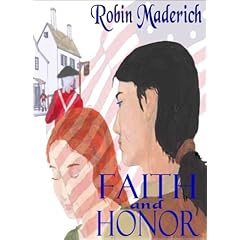
Faith and Honor by Robin Maderich

One of the reviews on the back of Faith and Honor says, "...the right mix: history, romance, sex..." That pretty much perfectly describes the book for me. This book was one of those that I just couldn't put down from the minute I picked it up. The story is very Romeo and Julietesque, which is a story line that always sucks me in. But rather than being lovers from separate families, they are lovers on different sides of the Revolutionary War.

Faith Ashley and Fletcher Irons are perfect for each other. Other than the fact that Faith is helping the colonials smuggle firearms out of Boston and Fletcher is trying to catch the people doing the smuggling. But they are destined for each other and of course fall easily in love quickly after meeting. The book is about trying to maintain their relationship in the midst of a battle greater than either of them.

Maderich develops her characters wonderfully, and you feel for the couple as they try to prove that love can beat all odds. They quickly find that it can't. I'm not sure how historically correct (only because I don't know a whole lot about it) the book is about the Revolutionary War and the comings and goings of Boston at the time, but I felt like I was in a different time than my own while reading this novel. The story is somehow modern even though it's set in a different era, and I loved almost every minute of reading it. I recommend it to anyone that enjoys a good Romeo and Juliet story and/or historical romance novel.

April 19, 2009

The Amber Room by Steve Berry

I could have sworn I'd reviewed The Romanov Prophecy by Berry, but it doesn't come up in the search tool.

"But Marie," you may be asking, "why on earth are you reading Steve Berry's books? You thought The Templar Legacy sucked!"

Yes I did. And I still do. Some of you may remember I even wrote a spoof of this type of novel on my blog. But I am a sucker for History, and while Berry may be a bad novelist, his History lessons are pretty good, if not a tad biased and misguided as we saw in The Templar Legacy.

I picked up The Romanov Prophecy a couple months ago because I have a weakness for anything Romanov. It was good, much better than The Templar Legacy, actually almost believable. In fact I'd give it five stars. And I found out when I read The Last Tsarina by Carolly Erickson that his research was just about flawless. So when I saw The Amber Room, another Romanov-related piece, I grabbed it.

Blah.

Turns out The Amber Room was Berry's first novel, and it shows. It would be a great book for someone who just wants the thrill of an adventure novel with car chases and shoot-outs and heroes dangling from precipices, but I'm really not into all that stuff. I want good research, a compelling story, believable characters, and intrigue. The only one of these that exists in this novel is the research.

All of Berry's female characters in this book are identical. Same woman, different hair color and a name change. They're all aggressive bombshell Bond Girls that treat men the way men usually treat women in these books. And Berry's men like it. The men are more varied, but they're all a bunch of cold fish, with the exception of bad guy Christian Knoll. He's the only character I managed to like. I got the idea that Berry liked him too, and that while he worked really hard to make Knoll appear bad, he couldn't help but pour all of his energy into developing that one character.

One thing Berry did in this book that was simply unbearable was to constantly repeat himself. There are three or four different sets of people looking for the same thing, and they each come across the same things at different times, and each time they do he must explain the thing all over again. It's like visiting a senile relative that can't remember that they already told you last time about the night nurse stealing their memory foam slippers. And the time before that. And the time before that.

But the worst crime Berry committed in this book is that he somehow made the story of an epic missing treasure boring. I was fascinated by the Amber Room before I read this book, now the very name makes me yawn.

But if you just want some good old fashioned Thomas Crown art action, you may love this book.

Related Posts Plugin for WordPress, Blogger...