Showing posts with label General Fiction. Show all posts

April 9, 2012

My Brother My Judge by Neal Wooten

Dustin and Trevor are brothers. Dustin is a responsible guy with a strong work ethic and commands the respect of everyone around him. Trevor is an apparent loser who lives in his mother's basement with his Star Wars memorabilia and comic book collection, building computer programs for friends and dreaming up far-fetched inventions. Both men are highly intelligent, but Dustin's humility prevents him from seeing it and Trevor's conceit camouflages it. Trevor is tired of his perfect brother underestimating him, and Dustin is tired of his loser brother being such a dead weight in the family. The only thing the two brothers have in common is their love for their nephew, Frankie.

One day, a bet between the brothers leads Trevor to create a computer program that can determine the outcome of any criminal court case. To the family's surprise, the program begins to create quite an impressive income for Trevor. It doesn't take long before government agents show up at Trevor's door wanting him to create a more comprehensive version of his program. The pay is so generous he jumps on it, giving little thought to what use the government might have for such a program.

Years later, the judicial system is changed drastically, juries and judges replaced by a computer, nicknamed Judgment, that could process each case and issue a verdict within seconds. Trevor is disturbed to see what his brainchild has become, but can say nothing for fear of death. Dustin thinks it's a great idea until Frankie is suspected of a crime and set to appear before Judgment. Dustin does what he can to help Frankie, but his research shows that Judgment only issues guilty verdicts and harsh punishment regardless of the evidence or lack thereof. Trevor and Dustin must find a way to work together despite their differences to save him.

When I receive lists of books available to review, it seems that more and more of them are just clones of recent bestsellers. I skim through the descriptions thinking to myself "let's see... Lovely Bones clone, Water for Elephants clone, Life of Pi clone, Eat Pray Love clone, Twilight clone, Twilight clone, Twilight clone..." etc. I am so tired of the lack of originality in "literature" today! Neal Wooten stands out as a singular Jedi in this clone army. His ideas are refreshingly original, and he is something of a trickster, throwing out surprises that catch even the most jaded reader.

What I enjoyed the most in this book was the relationship between the brothers and the way their statuses as opposites shift throughout the book. Anyone with siblings can relate to their struggles and their dichotomy as they attempt to get through life as a family. I definitely saw my own sibling relationships being played out, leading me to feel that Wooten himself must have some experience in this area. It is all very subtle, there's no overt leading of the reader or exposition on this subject, but the theme is solid.

When I reviewed Reternity last summer, I mentioned that Wooten's female characters weren't fleshed out very well. I'm happy to report that this is not so in My Brother My Judge. While still not occupying any main roles, the females are so well portrayed I can almost smell them. And I greatly appreciated the lack of formula romance. There is a degree of romance but it's sincere and mature. No heaving bosoms or getting caught in a deserted cabin in the rain with only one horse, one blanket, two petticoats, and a shoulder wound. So thanks again Mr. Wooten for an outstanding read, and I look forward to seeing what you come up with next!

post signature

February 12, 2012

Three and a Half Virgins by John Blumenthal

On the evening of Jimmy Hendricks' 40th birthday, his wife announces that she's had an affair with their neighbor and wants a divorce. This sends him into a tailspin, and he begins to regret certain things in his past, especially the way he treated certain women he'd deflowered. At the prompting of a poker buddy he sets out on a quest to track these women down and apologize to them.

When I read the description of this book, it reminded me of the cult classic High Fidelity by Nick Hornby. And as I read the book, there were other things that reminded me of -well- other things. The main character's struggle with his famous name is like that of Michael Bolton's in Office Space. The friend who struggles with halitosis and therefore speaks unintelligibly through a scarf is named Kenny, a la South Park. Author John Blumenthal's impressive portfolio -co-writer of Blue Streak, a hilarious movie, former editor for Playboy magazine, and contributor to The Huffington Post- seemed like a guarantee of an enjoyable read, yet it all felt flat to me. Blumenthal presents scenarios with potential, but they never got off the ground, at least not on my airfield.

All is not lost. The trouble is, I'm a woman, and a difficult one to please; an even more difficult one to get a laugh out of. I believe Three and a Half Virgins was at heart meant to be a man's book. If my husband read this book (he's too busy reading sales manuals), he'd love it. Case in point, it was my husband that pointed out to me that there were three and a half cherries on the cover, which got an eyeroll out of me and a chuckle out of him.

And there is a message here. One more comparison to be made. One of my favorite books, The Alchemist, tells the story of a boy whose search for treasure brings him right back to his starting place, teaching us that while we may go on epic quests to follow our dreams, our treasure is often found in what we already have. Jimmy Hendricks seems to come to that conclusion at the end of the book, he just doesn't seem very bowled over by it. Women like to be bowled over, and you can take that any way you like.

I received a copy of this book for the purpose of review.

post signature

January 25, 2012

The Dirty Parts of the Bible by Sam Torode

In this book, author Sam Torode imagines his grandparents living the the story of Sarah and Tobias from the Book of Tobit (which I have to admit to never hearing of before reading this novel) in the setting of the Great Depression. It's hard not to compare it to O Brother, Where Art Thou?, famously based on The Odyssey. Both stories are set during the depression, both are tales of a journey to find buried treasure, both have elements of magic realism, and both manage to do all this in an entertaining and redeeming fashion.

Tobias Henry is the sheltered young son of a Baptist minister. When his father snaps and loses both sight and position, he sends Tobias to retrieve money he had buried in his youth. Tobias confronts the real world for the first time, and immediately finds himself questioning his faith. There are too many things in the Bible, he realizes, that make no sense. Atheists are happier, he realizes, because they have no rules to follow except those they make for themselves.

As he ponders these things he loses his traveling money and finds himself riding the rails with a seasoned, endlessly knowledgeable hobo named Craw. In exchange for Craw's essential assistance, Tobias offers him a job on the family farm. Once they get there and are embraced by long last family, Tobias meets and falls in love with Sarah, who is cursed. But how can he help her if he doesn't believe in curses anymore?

The part of this book I enjoyed most was Craw's conversations with Tobias. The wisdom he imparts to his young friend is pertinent to anyone who has ever questioned their faith, or even the simple idea that our world is more than what we can overtly observe of it. This is a book to read with a mind opened to see past the literalism with which our society is so obsessed.

A caveat: this book does NOT qualify for the "Inspirational" category. There really are some Dirty Parts. I've read dirtier, but I know what the expectations usually are, so if you like your lit on the squeaky side you may want to pass on this one. ;)

post signature

October 18, 2011

The Language of Flowers by Vanessa Diffenbaugh

Summary: A mesmerizing, moving, and elegantly written debut novel, The Language of Flowers beautifully weaves past and present, creating a vivid portrait of an unforgettable woman whose gift for flowers helps her change the lives of others even as she struggles to overcome her own troubled past.
The Victorian language of flowers was used to convey romantic expressions: honeysuckle for devotion, asters for patience, and red roses for love. But for Victoria Jones, it’s been more useful in communicating grief, mistrust, and solitude. After a childhood spent in the foster-care system, she is unable to get close to anybody, and her only connection to the world is through flowers and their meanings.
Now eighteen and emancipated from the system, Victoria has nowhere to go and sleeps in a public park, where she plants a small garden of her own. Soon a local florist discovers her talents, and Victoria realizes she has a gift for helping others through the flowers she chooses for them. But a mysterious vendor at the flower market has her questioning what’s been missing in her life, and when she’s forced to confront a painful secret from her past, she must decide whether it’s worth risking everything for a second chance at happiness. 

I loved The Language of Flowers from beginning to end and I finished it in one lazy, rainy day. This book has been a highly hyped book in the newspapers and magazines and after reading it, I fully endorse the hype. It is a beautiful book with an amazing storyline and fantastic characters. Victoria is an incredibly damaged woman who has experienced the constant turmoil of the foster care system. The characters surrounding the story of Victoria are perfect and amazing additions to the story. I truly cannot say enough about the characters and how much I loved them as I followed their delicately linked lives.

The symbolism and themes of the novel were captivating and the writing so enchanting. From this point on, I will always think more of the message of the flowers that I receive and give, and I love that. I never realized how much a bouquet of flowers can really say. Through the various meanings of flowers, this book delves into life and all of its secrets. I highly doubt that my review and use of cliche phrases can begin to do justice to this novel so I will just stop here. The Language of Flowers is beautiful and highly recommended! 
  post signature

July 6, 2011

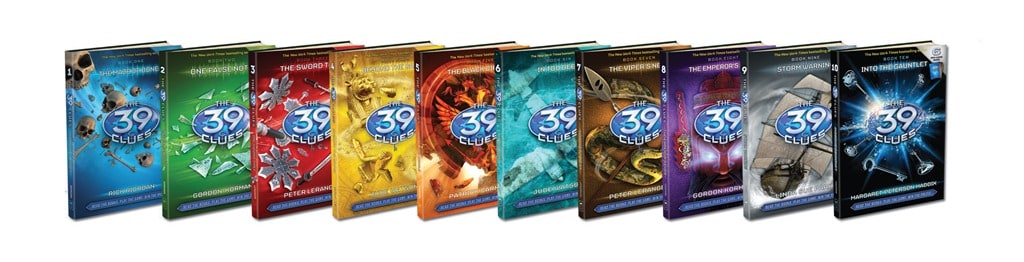
The 39 Clues by Various Authors (Books 1-10)


I just finished reading (well listening to as they were audiobooks) numbers 1-10 of The 39 Clues series. There are more coming (book 11 - Vespers Rising - came out in April) but book 10 ends at a very good stopping point before starting the next phase of the story. The books follow the quest of the 11 year old Dan
and 14 year old Amy Cahill around the world as they try to piece together the clues that form the basis of their families power. What power? Well, in the books, the Cahills are an extremely influencial family that has four branches. Famous people like Benjamin Franklin, Mozart, Shakespeare, and others are all included in the families geneology. Dan and Amy must follow clues and hints left behind througout the generations to find the ultimate prize - the power to rule the world.

These books are extremely well written. Each book features a new author - including big YA names like Riordan, Korman, and Haddix. And while that may seem like it would make the series choppy and disconnected, it doesn't. Rather, it gives an exciting and ever-changing quality to the books that fits in nicely with Dan and Amy's constant traveling and hunting. The characters are extremely well developed and I grew to care about Dan and Amy and their plight more and more with every book. The series has well thought out plot twists and the historical aspects are really engaging and highly believeable.

I must say also that the audiobooks, narrated by David Pittu, are some of the best recordings I have ever heard. He gives unique and distinctive voices to all of the characters. Check it out.

I would recommend these for all ages. 5 stars!


May 30, 2011

The Albuquerque Turkey by John Vorhaus

I asked to review this book because I live in Albuquerque, and I was hoping to "see" some familiar places. As it turns out Albuquerque barely figures in the story, but its still good fun, the sort of book many reviewers would describe as a "romp." Personally, my dignity precludes me from using that word. I won't use "quaff" either, unless I'm making fun of someone for being a wine nerd.

The Albuquerque Turkey is the (some might insert "rollicking" here) tale of a con man, Radar, whose girlfriend (also a con artist) has decided to go straight after a pretty big score (landed in a previous book, The California Roll). The two decide somewhat randomly to settle in Santa Fe, where they mull over what to do with the rest of their lives. Accounting? Teaching? Car sales? But when Radar's long lost estranged father shows up (also a con artist), their plans for reformation take a different turn.

Radar's friend and sidekick, Mirplo, also dabbles in reformation. He throws his hat in with the artsy crowd, pulling a con of his own as he pretends to be a great artist. Yet along the way he actually does become a great artist. Mirplo is only a supporting character, but definitely the most colorful, and my favorite. The name of the book comes from one of his pieces, a sculpture called -you guessed it- The Albuquerque Turkey.

This was a fun book. The writer has written books on the subjects of gambling and comedy, and he certainly seems to know his way around both. But what I enjoyed the most was Vorhaus's way with words. He masterfully manipulates language to say the same old things in new ways. A couple of his sayings that are now a part of my own vernacular are "verbal prostate massage" (sweet-talking your way out of or into something) and "audio waterboarding" (my new way of expressing myself when my husband plays AC/DC).

I received a copy of this book for the purpose of review.

May 11, 2011

The Swan Theives by Elizabeth Kostova

I'm always excited to see a big fat book I've never read before, doubly so if it's by a writer I'm familiar with. I grabbed this almost without thought during my last trip to the library, registering the writer's name with a mental golf clap, and salivated at its juicy width without actually knowing anything of the contents.

I reviewed The Historian by Elizabeth Kostova nearly two years ago. It was a compelling yet somewhat disturbing read, because it took a familiar myth, the story of Dracula, and made it seem plausible. It was psychologically dark, and several times its darkness made me feel I ought not to be reading it, but I am not one to put a book down unless it is phenomenally bad.

The Swan Thieves is also dark, but not in the same way. I never felt my soul was suffering for coming back to it every night. It's dark in a more romantic way, the way of impossible love and tortured artists and fascinating spans of History. It centers around painting, Impressionistic painting in particular. I do enjoy art but have never studied it and don't especially want to. I don't want to become one of those people that becomes so cerebral about brushstrokes and geometry and form and self-importance that they can't see the forest for the trees. I think there's a real purity about appreciating art in a state of ignorance. It's not an excuse; I have met too many art snobs that I have no wish to be like.

The Swan Thieves is the story of a troubled artist, Robert Oliver, who paints the same unknown woman in great detail obsessively and repeatedly. In doing so he loses his sanity and his relationships, until he is led to attacking a painting at the Met, resulting in his arrest and institutionalization. His psychiatrist, Dr. Marlow, a painter himself, is determined to get to the bottom of Oliver's issues. But when he is stonewalled by his patient he is forced to investigate on his own.

What follows is an interesting story of a talented female painter living at the time and space of Monet and other great Impressionists. As Marlow uncovers her story the reader finds it mirroring Marlow's own (a bit cliche in my opinion). He unravels a semi-great mystery and we find ourselves in a happily-ever-after scenario.

This was a good book, but not as riveting as The Historian. I had trouble getting into it and staying with it, not really getting interested until about halfway through. The first half reminded me too much of the film Don Juan DeMarco, although it's not at all comical. The mystery once unraveled isn't as climactic as the modern reader has come to expect, and the ending was too easy. Oliver experiences a complete full recovery as soon as Marlow reveals his knowledge of it, even though Oliver already has complete knowledge of it, and is released the next day. I don't like easy explanations or endings that seem to have come together under a looming deadline. I feel this book, while good, could have been better. That being said, I will certainly read whatever Kostova comes up with next, and hope she has learned from this one.


April 22, 2011

Oskaloosa Moon by Gary Sutton

Often the life of a reviewer can be tedious. We agree to review books because the description sounds interesting, and because it's actually available in paper form (which is getting rarer and rarer). Then it arrives and we realize maybe it wasn't what we'd hoped, but we'd agreed to write a review. So we trudge on through, throwing covetous glances at the stack of neglected books in our To Be Read piles. Why? Because we live with the hope that one day, one of these books that arrive in the mail will finally be worth it. It's like Edison looking for the right filament for his incandescent bulb. Or Darwin, measuring finch beaks on the Gallapagos. Only slightly more glamorous.

I did say "slightly."

I am pleased to announce that at long last I have found once such gem. Oskaloosa Moon isn't merely a good read, or merely a five star book. Its value is impossible to measure. In fact, its near impossible to explain, too. Before tackling this review, I read other reviews of this book and found I wasn't alone in this difficulty. This book doesn't fit into any one genre, yet it is simple. It can't be compared to anything else no matter how I stretch it, yet I can't stop trying to because it is so relatable.

Oskaloosa Moon is the story of a boy who was born with a disfigured face, but a completely normal mind and body. He grows up in a small town where he does his best to fit in, work hard, and make his family proud. But no matter how hard he tries, someone is always there holding him back. Despite this, he remains good-hearted, optimistic, and loyal. Because of this particular personality trait, some reviewers have compared him to Forrest Gump, but that doesn't quite wash. This is the basic story.

The heart of the story is that before there were laws protecting the disabled and public service announcements and children's books featuring kids in wheelchairs, the disabled - or those who are simply different in any way- found life incredibly difficult, and sometimes lived almost entirely segregated from "normal" society. Moon is the perfect poster boy for this group of people because of his disfigurement. He is also, however, the poster boy for us all, because all of us have been held prisoner in some way due to our own outward appearances.

It's one of life's big questions. Are we truly the way we see ourselves, or the way others see us? We can never know for certain, because no matter how we manipulate our appearances, no matter how hard we work to change our lives, others will only ever see us as they choose to, and act on that.

As I read Oskaloosa Moon I could easily see it as a book that will one day be standard reading in high school literature classes. I could also see it as a film. I could see Moon standing behind a film projector, the monochrome light pulsing over his hopeful face. I could see him walking down a San Bernardino sidewalk with the sunlight reflecting off his stunt helmet (before San Bernardino became mired in smog). And I could see in him every person who's ever ached to be truly seen.

I received a copy of this book for the purpose of review. It was a hardcover, not something you ebook snots can appreciate. And it was signed. Twice. Which really made me feel special. :)


March 31, 2011

The Sandalwood Tree by Elle Newmark

The Sandalwood Tree by Elle Newmark is a gripping story that examines relationships in all their glory and complexity. Marriages, friendships, families, religious groups, and class systems (just to name a few) are intertwined throughout the novel creating characters and experiences that have true depth. Evie Mitchell is a wife and mother in 1947. When her husband travels to India to document the end of British rule, Evie and their young son accompany him. Her marriage is severely strained because her husband has severe PTSD from WWII and India is on the brink of war over the partition dividing Hindus and Muslims throughout India. Soon she finds a pack of letters written between two Englishwomen in 1857 hidden inside her bungalow. The letters begin a search into a deep friendship between two women and the events that shaped their lives also bring insight into her own situations.


The Sandalwood Tree drew me in from the beginning and stayed on my mind even when I was not reading it. The book flashes between 1857 and 1947 without seeming choppy at all and I was interested in the main storyline and all of the side storylines equally. The story contains twists and turns that are entirely believable but not expected. I must admit that in certain parts of the book I cried openly! (particularly towards the end) I must also say that I know nothing about India or its history but that did not hinder my enjoyment of the story. Ms. Newmark makes the inclusion of Indian culture seamless and relevant. The best part about the book, however, is the message of love and togetherness. For example, “If I must choose between joy and caution, I choose joy” is one of my favorite quotes from the novel and stuck with me even after I finished reading.

This book is definitely worth reading. Get your favorite blanket, a tasty cup of tea, and settle in for a great read. Five stars!

Oh, and if you are interested, check out www.ellenewmark.com. She writes a blog, provides book club aides, and there is also a great Q&A section.

March 7, 2011

We Ain't the Brontes by Rosalyn McMillan

When I received my copy of this book in the mail I noticed that the author's address label showed a surname that had been crossed out, with "McMillan" handwritten in next to it. That innocent notation set the stage for my foray into the world of the Lavender (McMillan?) sisters.

Rosalyn McMillan, author of Knowing and The Flip Side of Sin, is the sister of Terry McMillan, author of How Stella Got Her Groove Back and Waiting to Exhale. Both sisters are well-known writers. I'd never read any of their books prior to this one, but had certainly heard of them. I was initially drawn to this book because the subject matter appealed to me, not because of the notoriety of the McMillans.

In We Ain't the Brontes, Charity (Rosalyn?) and Lynzee (Terry?) are both well known African American writers, but Lynzee has enjoyed somewhat more success than Charity. At the beginning of the book, Charity and Lynzee have a bitter fight over the right of both sisters to use their maiden last name professionally (the notation on the address label!). After this fight, Charity begins to find herself shut out of the publishing world, and she is desperate to find a publisher for her new book as she grows short on funds and is faced with losing her house. In the midst of this Lynzee drops a bombshell on her: years before, Lynzee had given birth to a baby by Charity's husband and given it (her) up for adoption. Now the child was grown and wanted to connect with her biological parents. Naturally this leads to severe difficulty in Charity's marriage. But then she is struck with a brilliant idea for a new book: a book about two sisters who are famous writers at odds with one another.

I have to admit, after reading the first few pages I was prepared to give a pretty scathing review. The first scene is rough, unfolds too quickly, and just doesn't seem realistic. It could have stood more detail, especially as the scenario -getting ready to attend the Essence awards as guests- is something I would have liked to get a better mental picture of. McMillan speeds through it, and the dialog seems forced. But after that things calm down a bit and begin to gel.

I really liked Charity, the main character. She struck me as a strong -yet flawed- woman with high self-esteem. She's driven and motivated and stands up for herself the way many women wish they could. At times I wanted to slap her, when she made bad decisions, but at the same time I could understand why she made them. As the book went on she became more and more multi-dimensional.

I do feel the writing was rough and at times cliched, but overall it sucked me in. There are many writers who may write better than McMillan, but can't keep a reader interested. The writing is catchy and upbeat, and you can really hear McMillan's voice. There were a couple of other things I thought were a little too easy; the characters seemed to have a much easier time coming out with difficult revelations than most people would have. It struck me as odd that the characters were real potty mouths yet professed strong Christian faith. And that these strong Christian women think nothing of dropping thousands of dollars on expensive clothing, yet the only time charity is mentioned is when there is excess food at a party and Charity donates the leftovers. At the same time, it is rather realistic. In fact, if Charity had spent every spare moment in a soup kitchen she probably would have annoyed me to no end.

There are a few scenes that seem extraneous, like one in which Charity survives a plane crash and breaks her leg, a momentous event that has no bearing on the rest of the story. And the main plot of the book concludes well before the book ends, and then subplot finishes it off, which just doesn't fit the normal flow of a novel. Yet real life doesn't tie off so neatly either.

Beyond the essential storyline, I had a growing awareness that the book must be at least partly biographical, and I frequently put the book down to Google one tidbit or another. In addition to the issue of the last name (of course I have no way of knowing if this was ever a point of contention between the McMillans), I found two other things that pointed to this possibility. It was difficult to find much biographical detail on either sister; most seemed to focus on Terry McMillan's famously publicized divorce. I did find a paragraph about their childhood that paralleled that of the Lavender sisters in Brontes: a father that died young, a mother working several jobs to support the family, the elder sister caring for the younger. Also in a critical review I found of one of Rosalyn McMillan's earlier novels, she had flubbed a scene in which her characters entered the same room twice. In Brontes, Charity sends a manuscript to a book doctor in an attempt to make it more appealing to reluctant publishers. In fact the book doctor makes it worse, inserting a scene in which the main character leaves her home twice. Coincidence?

Overall I enjoyed this book very much. Rosalyn McMillan is not a perfect writer, but she is passionate and creative. I'd rather read a flawed work of passion than a perfect work of boredom. I read it in a couple of hours because I just couldn't put it down. And I'd love to know if any of it is true!


I received a free copy of this book for the purpose of review, no other compensation. Click on the image above for a short video about the book.

November 17, 2009

Tirissa and the Necklace of Nulidor by Willow

Tirissa and the Necklace of Nulidor is the first book I think I've ever read by an author with no last name (or maybe that is her last name). It's a fantasy novel about Tirissa, a wood fairy, as she tries to save her family and friends from an evil wizard along with the help of a massive troll and a short and plump guard. They travel through many magical lands and meet many magical friends (and foes) along the way and always come up with some way to continue.

I really enjoyed the first half of this book; it was exciting and new and the idea of a perilous adventure among these three characters put together in such a random way seemed intriguing but by about two chapters into their journey I got bored and just kept hoping they would make it already. I felt like the second half of the book was the same thing over and over again. The group meets one dangerous opponent and figures out how to get past them. The group meets another dangerous opponent and so on. By the time they finally met the really dangerous opponent (the evil wizard) I was just skimming pages to see how they would beat him and save her family.
But I did enjoy this book and thought that the basic story line was good and a creative idea. The characters were developed enough that you could predict how they would act based on your knowledge of their character. So overall an okay read but not something I would pick up again.

3 out of 5 stars.


August 31, 2009

Coming Attractions by Robin Gunn

I was given a copy of Coming Attractions by Robin Gunn to review by the publisher as part of a blog tour. The first thing I noticed when I got the book was that it was part of a series, the Katie Weldon series. I don't know about you, but I'd never heard of that series (or Gunn's other series, the Christy Miller series) before so I was intrigued. I'm a sucker for a good series so I was pretty excited when I first started reading the book.

And I was still excited the next day when I got to the last page of the book and Gunn left the ending somewhat open, like there will be another book in this series. I'm not sure if that's true or not, but if it is, I'll definitely pick it up.

Coming Attractions is about Katie Weldon. She's a senior in college, has great friends, the perfect boyfriend, and everything all laid out in straight lines to where she eventually wants to go. The problem is that Katie doesn't really like straight lines, she likes wavy ones. With the help of God and a boyfriend a little too eager to get married when he learns about her large inheritance, Katie figures out how to get back to the life she wants to lead instead of the one she thought she was supposed to.

Gunn's writing is easy to understand and read, her characters are extremely relatable (who hasn't wished their life were more spontaneous and less planned out), and the story moves along quickly. The only part of the book that could have been improved for me was that the plot was fairly predictable, but it ends happy, which I couldn't complain about. I knew what was going to happen from reading the back cover and the first chapter of the book.

With all of its positives and negatives, this is a good read if you have even a little bit of free time. Nothing ground-breaking, but a good positive story to help remind you to follow your heart even if it doesn't seem like the best decision to everyone else. 4 stars.

July 15, 2009

Three Reviews: Jewel, Gilgamesh, and Made in the U.S.A.

I've really been slacking on book reviews, so I have to play catch-up. I have to hurry too, because there's a sleepy baby grabbing my ankle.

Jewel by Bret Lott

This was an incredible book. It's the story of a woman's life, from her childhood in rural Mississippi pre-WWII, to her marriage and motherhood -culminating in the birth of a disabled daughter as the story begins- and old age. After this daughter (her sixth child) is born, her life is taken over by the special demands involved. Her marriage and friendships suffer. Finally she convinces her husband to move to California, where an organization for disabled children is making progress. It's difficult to describe this book accurately. It would be easy to paint as another "disabled child" story along the lines of The Memory Keeper's Daughter, but there's much more to it than that (as there was to The Memory Keeper's Daughter). This book follows recent American History, allowing glimpses into lives trying to keep up with rapid change and progress and the ups and downs of economy and culture. Five stars.

Gilgamesh by Joan London.

I'll be honest, I know nothing about the Epic of Gilgamesh. If I did, maybe this book would have had more of an impact on me. This is a story of hopelessness and pointlessness. At least that's how I see it. A girl growing up in the Australian bush pre-WWII with a mentally impaired mother and a self-righteous sister gets pregnant by an exotic visitor. After the baby is born she decides to try to find the baby's father in Armenia. So she goes there, spends a few years taking care of two thankless invalid women, hoping to find the man. One day she suddenly gets word that he'd died, and she has to go back to Australia. So she does. And raises her son in the bush. The end. No point as far as I can see. Three stars for good writing, but that's about it.

Made in the U.S.A. by Billie Letts

My mom's family has a big thing for Billie Letts, because they are Oklahomans and so is she. So I've read all her books, starting with Where the Heart Is when it first came out. In Made in the U.S.A., Letts attempts to get into the mind of a rebellious teenaged girl. Since I've never been one, I can't really say how she did on that score. Lutie and her little brother, Fate, are orphaned (can I just say here that I'm really darn tired of writers using all these portentous names? What's wrong with real, typical names like Haley and Zack? Emily and Jacob? Abby and Hunter?). Terrified of being shoved into foster care, they steal a car and head to Vegas, where they live in their car and struggle to get on their feet. This was a really good read. Nothing mind blowing or anything, but a good, fulfilling read. Four stars.

June 19, 2009

Standing Still by Kelly Simmons

Awhile back, Ronnica notified me that it was my turn for a review book, and told me about the one that had come up. I was excited that it was my turn, but the book that was up for review didn't really interest me, so I asked if I could hold out. I continued to hold out for about four more books, then this one came up, and I'm so glad I waited.

Standing Still is the story of a married woman with three children who suffers from a panic disorder (check, check). One night she finds an intruder in her daughter's room about to take the child away, and makes the surprising request that he take her instead. And he does.

That is the premise on the surface. Beneath that is a wife's adventurous past, a husband's secrets, and a bereaved man's act of desperation. As a woman, I admired this duality of plot. When a woman marries and becomes a mother, she is basically forgotten as far as society is concerned. The fairy tales end when the princesses get married, after that who cares? But as we all know, life does continue, and continues to hold surprises and mystery and growth. Simmons gets that.

The book is also very well written. Before I read it I found a quote comparing it to Bel Canto. I thought those were some big shoes to fill and was prepared for disappointment, but Simmons definitely filled the shoes. Standing Still doesn't have quite the scope, but makes the attempt, and Simmons' graceful style effortlessly envelopes the reader into her characters' lives. My only complaint is that there were a couple strings left dangling at the end, strings I was really hoping to see nicely tied up. She may have done this for the sake of reality, or maybe even a sequel. I'm hoping for the latter.

May 29, 2009

Run by Ann Patchett

After I read and loved Bel Canto, I checked my library for more books by Ann Patchett, and found this one. Run is the remarkable story of an Irish American family that adopts two African American boys. After only a few years of being a family, their adoptive mother dies, leaving them to be raised in an affluent neighborhood by the mayor of Boston. When the boys are grown, on one fateful night, they both find and lose their biological mother. This is an extraordinary book about familial relationships.

The most amazing thing about Patchett's writing to me is her ability to get the reader inside her characters' heads. She doesn't just make up characters and build a story around them. She puts on her characters' skins and becomes them, and they are the story.

I was surprised by Patchett's photo on the book flap. I was expecting a matronly middle-aged woman with short hair and knowing smile, but she looks like she's probably my age. I was not surprised however by the multiple awards and accolades credited to her in the bio.

May 9, 2009

These Is My Words by Nancy E. Turner

These Is My Words is an account of fictional pioneer woman Sarah Agnes Prine in the Arizona Territories. Written like a diary, it starts when she is 17 on the trail with her family from Arizona to Texas, and ends when she is in her mid-30's (to be continued in a sequel called Sarah's Quilt).

Sarah is like a combination between Scarlet O'Hara, Annie Oakley, and Sarah Plain and Tall. She's a crack shot and doesn't think twice about taking a life (or two or three) if family or friends are threatened. She's a very hard worker and craves an education more than anything. But she also wants to be a real lady, and struggles to fit that bill while doing the things necessary to survive in a lawless wilderness.

This book was amazing. I really came to love Sarah and many of the other characters. And this is one of those rare gems in which the romance really tugs at you. It seems like Turner wanted to see what would happen if Scarlet and Rhett were Western characters instead of Southern (although I couldn't stand Scarlet, Sarah is much more likable). In fact the more I think about it, the more parallels I see.

This book was impossible to put down. It's not a skinny book, but I read it in less than a day and immediately put Sarah's Quilt on hold at the library. I hope the sequel isn't a disappointment as so many sequels are.

April 30, 2009

Bel Canto by Ann Patchett

Wow.

I could just leave it at that, but I think you probably expect something in the way of an explanation, eh?

Bel Canto is the story of a hostage situation in an unnamed Latin American country. This is not a crime novel. There is no gritty tragic detective trying to save the day or anything of the kind. The story is not in the crime itself, but in the situation it creates. 200 fabulously wealthy and famous people from around the world have gathered at the Vice President's home for a private concert of great opera star Roxane Coss. There are diplomats and corporate moguls, as well as a translator accompanying his boss and an opera loving priest who was allowed to listen from the kitchen. As the concert ends, suddenly the lights go out and a small army of rebels descends from the air conditioning vents. A standoff follows.

So what happens when a crowd of rich and influential people is forced into close quarters with a pack of teenagers from the jungle for an extended period of time? Again, not what you'd expect.

There are so many beautiful things about this novel. The premise in and of itself is elegant. But there's more. This book is, as people like to say, multi-layered. But it's not layered with the precise and definitive textures of an onion or even a parfait. It's more like a fine chocolate, with so many things to appreciate: the depth of flavor, the sweetness, the bitterness, the texture, the way it melts on your tongue, the aftertaste, the scent.

In the first place there is the writing. I'm from the Stein / Hemingway school of thought. A word is a very pure thing and ought not to be used carelessly. It's easy to see when a writer not only chooses her words with care and taste and precision, but when she really loved that word and savored it on her tongue. That's what poetry is supposed to be, a boiling down of language, a story in a few potent words. And that's the way Patchett writes. Don't misunderstand; she's not one of those horribly annoying people that uses melodramatic adjectives in place of sentences. Rather her sentences are composed of only the most perfect words; nothing more and nothing less.

Then you have her character development. The way the novel begins with a quick sketch of the crowd and its major players is the way many novels simply continue without further development. But Patchett keeps going, gracefully, diving a little deeper each time before letting us up for air. You really get to know and love the characters, in an easy organic fashion.

Then you have the situations she sets up. Usually in a book that involves hostages and terrorists there will simply be a lot of struggling with ropes and halted conversations between clenched teeth about escape routes and weaponry. Patchett is much more realistic. How will these people interact as they prepare meals, wait to use the bathroom, watch television together? Most writers skip over these scenarios, wanting to get at what they see as the meat: escape, rebellion, fighting! But Patchett's drama exists in these very spaces. And it is in those spaces where people fall in love.

And then there's the linguistics. The guests at this party are from all over the world. There are Russians, Germans, Japanese, French, Spanish, Dutch, American, and more. The terrorists themselves speak a local language and only a smattering of Spanish. Enter Gen, the lone translator, who is caught in the middle of negotiations, requests to use the facilities, declarations of love. It's a study of how people can communicate with and without the use of spoken language, what language can and cannot do for us, and more universal languages that transcend words, like love and food and music.

Music! Everyone listens to it, but I wonder how many people really love it. A lot of people casually say they love music, but does that mean listening to the radio on the way to work, or does it mean laying on the grass, tears rolling helplessly down your face as the vibrations of it radiate through you? It's this second kind of love we see in this book. Roxane Coss sings in several different languages that she herself does not speak, but the words don't matter. It's the language of the music itself that resonates and enraptures the hostages and captors. If you've never heard a live performance of orchestra or opera, you may not understand this. Believe me, it is not the same stuff you hear from a speaker. And it's even more so to anyone who has ever played an instrument. The characters' love and awe of Coss' music is transferred to Coss herself, who enjoys attentions no hostage before has ever dreamed of.

There's only one thing I didn't like about this book; then ending. Not just because it was over, which was a very sad event, but the ending just didn't seem to mesh with the rest of the book. It was too final, too decisive, and a little nonsensical.

Even bearing that in mind, I would give this book a thousand stars if I could.

March 10, 2009

Saint Maybe by Anne Tyler

Have you ever wondered how something you have said or done might have effected the lives of others? In this book, young Ian Bedloe's words drive his brother to suicide, leaving his young widow and three small kids helpless. In his guilt and despair, Ian comes across The Church of the Second Chance, an odd Bible based faith that practices penance for misdeeds. For Ian's penance he must set aside his education and his girlfriend to raise the orphaned children. In Ian's quest for God's forgiveness he learns there is a lot more to being forgiven than penance, and also a lot less.

Anne Tyler is very well known for An Accidental Tourist. I've read several of her books now and they never fail to disappoint. Most writers seem to just have one good book in them, but Tyler just keeps on going. This plot could have easily been turned into a religious cheese-fest, but Tyler stays away from both religion as we know it and the fondue pot. She illustrates well how quick we are to jump to conclusions about others, and the consequences that can result from our assumptions. I highly recommend this book.

March 6, 2009

Villa Incognito by Tom Robbins


What i found in this book is that it was a whole lot of filler to tell a story that probably could have been told in about 50 pages. True to his style, Robbins does manage to throw in some good comedic points, and he truly is the master of the metaphor, but this time I didn't feel it was enough. I had read this book once before, and didn't like it much then either. I was hoping that this go-round I would enjoy it more, as it's been a good 5 or 6 years. No, sadly.

This is not one of Robbins' better novels. While I do enjoy most of his work, "Skinny Legs and All" being one of my favourite books of all time, this one is just didn't do it for me. Robbins jumps around from past to present, and after reading 4 or 5 pages of dialogue that doesn't seem to fit into the whole package of the book, I found myself wondering if he just didn't meet his required amount of words and was padding.

Would I recommend the work of Tom Robbins to another person, yes. Would I recommend this book? probably not. It just didn't captivate me the way "Another Roadside Attraction" or "Jitterbug Perfume" did. In fact, I found myself, many a night, almost forcing myself to continue reading it.

I give this 2 stars. Well written, just not entertaining.

February 26, 2009

The Memory Keeper's Daughter by Kim Edwards

This is the third review of this book on The Book Nook, and the first two weren't incredibly positive. I have to disagree with the previous two. In some ways I think that's because relating to this book requires a certain life experience, which I've had, growing up poor and trying to put that behind me, and also having made a horrible mistake that seemed like the best decision at the time but turned into a destructive force in my life. No I will not elaborate.

Beyond that I think this book should also be recognized for the truly incredible writing. Edwards creates photographic snapshots as she writes that really place the reader within the story in a visual way. In fact photography is a theme in this novel, a very effective one, and it amazes me how she wove images with words as crisp and poignant as photographs. Not many writers can do that. I do appreciate a writer that allows me to use my imagination, but it drives me nuts when a writer describes nothing at all, expecting me to do all the work. Edwards creates a nice balance while also placing the reader in a sort of literary viewfinder. It's very effective.

Many books out there make me snort and say, "pssh, I could have written that." Well, I could not have written this, and that's a compliment.

I won't go into the plot because the two previous reviews did that sufficiently, you can do a quick search in the search box if you're interested. I only have two complaints. The character that the plot revolves around, Phoebe, is poorly developed. I can see why that is, it would be very difficult to get into the head of someone with Down's Syndrome. But she's only described physically, we see very little of her personality. Also the ending just kind of fizzled out, and that's frustrating. Otherwise, four stars.


Related Posts Plugin for WordPress, Blogger...