Showing posts with label informational. Show all posts

May 21, 2012

The Power of Habit by Charles Duhigg

I am a self-help junkie. I love to read books that promise they can change my life if I just follow a few easy steps. So I'll admit I originally agreed to read The Power of Habit because I thought it was another self-help book that could make me become a better person. It wasn't. It was even better.

The Power of Habit is a book written about the science behind habits - what habits are, why they exist, and how they can changed. It talks not only about habits in individuals but also about habits in successful organizations and how organizations use the science of habits to be more successful. Do you ever wonder how Target can send you coupons for the exact thing you need at the store or why you find yourself drawn to the Cinnabon counter in a mall? This book explains those ideas and best of all, it explains how you can change habits.

Has this book changed my life? No. Could it? Yes, I do believe it could if I followed the principles laid out so simply in the book. Regardless of if you want to change habits in your own life, this book is definitely worth reading. It was fascinating to learn about the science of habits and how I can drive myself home when I couldn't give someone directions to my apartment to save my life. This book was filled with so many incredible insights and I highly recommend it to anyone. 5 stars.

post signature

November 6, 2011

Columbine by Dave Cullen

How do you even begin to review a book like this one? To put your thoughts down in words about a book so real, so disturbing, and so well written? It's hard to figure out my own thoughts, let alone write them for you to read and analyze. But I'm going to try because this is a book that should be read and a story that should be understood.

Columbine by Dave Cullen is a non-fiction book that explains not only the how, and what happened during the Columbine High School shootings on April 20, 1999, but the why. It delves into the lives of not only the victims of the shooting but the shooters themselves, and I think that's why this book is so necessary. While the book is factual and based on years of research and interviews, it reads like fiction and at times you forget and are incredulous that this tragedy actually happened.

Cullen jumps around from the years leading up to the shooting, to the day of the shooting, to the days and years following the shooting. This type of writing structure can be dizzying and confusing in other books, but in Columbine it works in a way that allows Cullen to fit together all of pieces of this confusing puzzle. The other thing that I loved about this book was that it presented the evidence without assumptions and without placing or avoiding blame. When a tragedy occurs, people always want to know who's at fault. Cullen presents the facts in a way that they are really just that, facts. At no point in the book did I think, oh Cullen thinks that it's the fault of this person. Or that if this person did this, Columbine wouldn't have happened. Because really, you never know. No matter what anyone did, it still might've happened and I appreciate that he didn't dwell on the "what if," but rather focused on the reality.

In short, while difficult to read because of the disturbing nature of the subject, this book was one of the best I've read in a long time and I recommend it to anyone, again with the caveat that Cullen is transparent in his knowledge. He presents the facts and tells things like they are, which at times is tough to handle. But in the end, when tragedy occurs, people want to know why. And through Columbine, Dave Cullen helps readers understand why. 5 stars

Check out Sarah's thoughts on the book in her review from September 2010 here.

 post signature

July 5, 2011

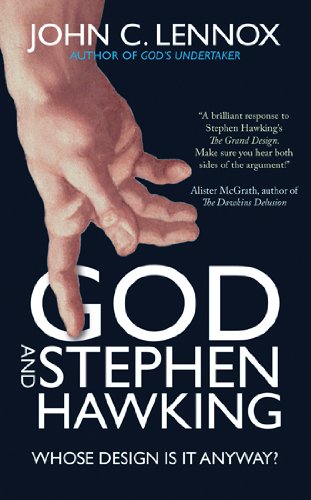
God and Stephen Hawking: Whose Design is it Anyway? by John C. Lennox
I was interested in this book for a number of reasons - the main one being that I have read a few things from Stephen Hawking and while I found his writing engaging and informative, I have always wondered - Where's God? All kinds of scientific theories are put out into the world but God seems to still be a very taboo subject for scientists and academics. This book may provide an interesting perspective for students attending online Christian colleges. So it was interesting to read something that responded to a very openly atheist scientific work from a Christian point of view.

Lennox does a great job of making some rather complicated ideas understandable. It is a short book but definatly full of thought-provoking questions. The beginning of God and Stephen Hawking opens with an argument against Hawking's controversial statement that "Philosophy is dead". Lennox asks if the questions Hawing debates in his book - Where did we come from? How did we get here? - are not themselves philosophical questions. The book follows this same pattern of taking an argument, disecting it, and refuting each point.

Overall, I learned a few things and have kept it in my personal library for future reference. Worth a read if for nothing else than it makes you think about your personal views and where the current scientific trends fit into them.

June 28, 2011

Title Intentionally Withheld

I am withholding the title of this book for the moment because I believe it is a confusing one. I will reveal the title shortly, I promise.

This book is a chronologically arranged collection of short biographies of Historical figures, 365 of them to be exact. Each biography is one page long, with footnotes of interest and occasional illustrations. From Khufu to Bhutto, they're categorized as Leaders, Philosophers, Innovators, Villains, and more. Many are familiar, some not so much, but all are fascinating. The writers were fairly objective with controversial and religious figures.

I keep this book on my nightstand. I don't read it daily, but I do pick it up frequently and often use it as a reference tool. It came in especially handy when I was watching the series Rome. I've found it to be fascinating, helpful, and enlightening.

So what is this book called? The Intellectual Devotional: Biographies, by David S. Kidder and Noah D. Oppenheim. I withheld the title because while it is technically a correct title, I'm afraid it gives the wrong impression. People are accustomed with seeing the word "devotional" attached to books offering religious meditations, and there is nothing religious about this book. I didn't want this aspect of the title to cause anyone not religiously inclined to skip this post.

I received a copy of this book for the purpose of review.

January 8, 2011

Super Life Secretcodes by Great Sun

I am generally an open-minded person. I have pretty defined views on religion and spirituality in my own life but an pretty open minded when it comes to other people's views and spirituality. I agreed to read Great Sun's Super Life Secretcodes because the premise of the book sounded intriguing - secret codes to help you change your life for the better. Who couldn't use a little help right?

This is one of the first books that i have agreed to review and just couldn't finish, which I feel terrible about but I felt like someone was standing above me saying that up is actually down, vampires actually exist, and the man who write this book was actually able to solve my problems with his spiritual superpowers. I know that sounds harsh, but it was difficult for me to read the first couple of chapters where people's problems were solved just by meeting with someone. I am open-minded, but this supernatural/psychic writing was too much for me after the first 50 pages. I tried reading a couple of the later chapters and was just as uncomfortable. And I made the decision that it may be unprofessional of me to not finish reading the book, but that risk was better than putting my mind through reading something that was so against my beliefs, judgement, and heart.

The writing was fine, but the content was not for me so I give this book just 1 star and don't in any way recommend it to anyone.

May 21, 2010

O Me of Little Faith: True Confessions of a Spiritual Weakling by Jason Boyett

When this book came up for review I was excited to get the chance to read it. I'd never heard of the author and I'm not generally a reader of non-fiction, but lately I've become interested in the subject of apologetics.

I grew up in a Pentecostal Christian home. I never questioned any of what I was taught. I remember getting into a discussion my senior year of high school with a bewildered librarian who simply could not wrap her brain around my stalwart faith. I battled Jehovah's Witnesses and Mormons, ripping their dogma apart and sending them home with with their own faith in tatters. I did always feel strange about things like speaking in tongues and being slain in the spirit. Having extensively studied the scriptures I knew that only some were to have such gifts (1 Corinthians 12:8-10), and it was clear there was a lot of play-acting going on. In my church I went against the flow, the lone solid stump below the swaying canopy of a windy forest. All that waving around and noise-making just felt wrong to me.

Then I started college, and that's where doubt really begin to set in, especially as my study of evolution coincided with my life-long pastor running off with the multi-million dollar church building fund. I wrote a bit about this time in my last review.

I can't really put my finger on any one thing that finally brought me back to the fold, but I didn't come back because my doubt had been dispelled; it never has been. So my attraction to apologetics is born of a desire to give credence to this way of life I've chosen.

I don't know why I always expect books to hold these huge answers for me. Books are written by people, not God, and people have puny little brains. Even the smartest of us can barely hope to do more than ask a really intelligent question, which inevitably leads to another question. No matter what science dreams up, there's never an absolute answer. Each question branches off into two or more new questions, and those questions get in a bitter argument over which question is more accurate. Blah! Yet I still expected Jason Boyett to answer my question of faith.

Instead, this book is an exploration of the question, which Boyett struggles with at least as much as I do. It is also a "coming out" of the question. In Christianity there's a lot of pressure to be perfect, and that means having perfect faith. Anyone admitting to less than that is either avoided or quarantined until he or she can be duly straightened out by pastoral counseling and a major laying-on-of-hands at the post-service altar call when everyone really just wants to get to Applebee's. So this was a very brave move for Boyett, especially as a respected writer in the Christian genre.

I respect that, and I'm glad I'm not alone. And I'm babbling on and on about myself because Boyett seemed interested in other tales of doubt, and he may read this and appreciate mine.

If you've read any of my reviews, you know I'm a bit of a Nazi when it comes to content, plot, organization, grammar, voice, and style. I probably go overboard in this area a lot of the time, but considering that getting a book published (by a real publisher) at all is akin to winning the Lotto, I think I have a right to be picky. Because somehow people that abuse sentence fragments and try to wrap two plots together that having nothing to do with one another keep getting in (*cough* Dan Brown *cough*).

Like I said, I'd never heard of Jason Boyett before this book was sent to me (free for the purpose of review, here is your requisite disclaimer). I wasn't halfway through the first page before I was struck by the thought that the book read like a blog. And the more I read, the more that thought stuck. This isn't really a compliment. In my opinion a blog has its place, and that place is on the InterWebs, not between the covers of a duly published book. Boyett's writing style is a strange combination between frat boy and scholar. His organizational strategy is just about non-existent. It seems as though he wrote this book the exact way I'm writing this completely unorganized review: by sitting down one day with a cup of coffee and just writing whatever popped into his head on the subject. It's not uninteresting, but it could have been done better. It should have been done better, the subject matter deserves it. We're talking about our eternal souls here, Jason!

When I finished the book I discovered that Boyett is indeed a blogger and has been for a few years. Having been there myself, I claim the right to be both sorry and snide. Or apologetic as the case may be.

If you are a Christian doubter yourself, or are outside the faith and curious as to how a doubter can remain a Christian, this book could be interesting for you. If you are short on time or have the attention span of a chipmunk, I suggest picking it up and just reading the last chapter. The last chapter says everything the rest of the book does, but seems to have been written with more forethought and weight than the preceding nine chapters.

I leave you with a quote from the last page of the book: "I'm a Christian, but I'm a big fat doubter. And I have to be honest: there are times -a growing number of times- when I'd rather be a doubter than have it all figured out."

And I also leave you with a question, which is how all things inevitably end. Why, Jason Boyett, does the little boy on the cover have band-aids on his nipples?

May 10, 2010

The New Rules for Mortgages by Dale Robyn Siegel

I initially agreed to review The New Rules of Mortgages because honestly I know nothing about buying a house or getting a mortgage, and I thought that this book would help out a beginner like me. And it did.

The book is broken into eleven different chapters full of extremely useful information for both a complete novice when it comes to mortgage related terms and someone that is a little more familiar with the information. The information includes things as simple as to what makes up your credit score to advice on the best type of loan for your situation and how the loan process actually works. I found the book very helpful in learning how the process works and what a lot of different things (e.g., fixed price versus adjustable) loan meant. However, there were also a lot of parts of the book that went right over my head because I'm a bigger to the language used so there were sections that I just skimmed altogether because I knew I wouldn't need information on getting a mortgage with a bankruptcy on my record for example.

Overall, I found this book to be very informative, and I'm glad I read it. While it was a little dry at times, Siegel did a good job of keeping most of the information relevant and concise. And now when I'm watching HGTV or listening to people talk about buying a house, I might actually know what they are talking about. I recommend this book mostly to beginners to the mortgage process and anyone who is trying to get a handle on things before even beginning to apply for a loan/mortgage. 4 stars.


June 26, 2009

Sophie's World by Jostein Gaarder

I never took a philosophy class. In fact, I didn't really have much of an idea of what philosophy was. I basically thought a philosopher was someone who wore a toga and said cryptic things. I was mostly wrong.

Sophie's World is part novel, part history of philosophy. It's about a Norwegian teenager who begins a correspondence course on philosophy with a mysterious stranger. As their interaction progresses, she learns a lot about philosophy in a very short time, and is at the same time bewildered in changes she begins to see in the world around her. She receives postcards meant for a girl named Hilde, and these cards turn up in odd places. She finds clothing in her closet that doesn't belong to her. She meets Winnie the Pooh, Little Red Riding Hood, and several other literary characters. The more she learns and the more things she sees, she and her teacher have to wonder about the fabric of their world. What is its true nature? Who is Hilde? Are any of them even real? What is real?

This is a very trippy book. It can also be boring at times. I found the sections on the Greek philosophers fascinating, the ones about Darwin and Freud even more so, but the others I had a hard time wrapping my brain around. I still don't get Existentialism. I can't stand Albert Camus. It also explores the big questions: do we have a soul? What is a soul? Is there a God? An afterlife? Is time linear or cyclical? What are we made of? Is evolution and the Big Bang God's method of creation or a separate scientific path?

This would be a great book for anyone who is curious about philosophy. And now that I have a better understanding of the subject I really think more people would live fulfilling lives if they read up on it.

June 23, 2009

The Drunkard's Walk: How Randomness Rules Our Lives by Leonard Mlodinow

My husband, a big time engineering/math geek, recommended The Drunkard's Walk: How Randomness Rules Our Lives by Leonard Mlodinow. Not being a big time engineering/math geek, I was a tiny bit leery, but took the plunge anyway.

From the dust jacket: "Offering readers not only a tour of randomness, chance, and probability but also a new way of looking at the world, this original, unexpected journey reminds us that much in our lives is about as predictable as the steps of a stumbling man fresh from a night at the bar."

In this book, Mlodinow discusses topics in statistics and randomness using real life examples. Some of it is incredibly interesting. Some of it I admittedly found a little dull. Overall, though, it was well worth spending the time to read. This is not a "math book" or a textbook. Rather, it is written at a level that should be accessible to most non-mathematicians.

One of the parts of the book I found most interesting was that Mlodinow posits that much of what we attribute to individual success or failure is at least partially attributed to randomness. Is Bill Gates really that much more amazing that all the other very talented computer programmers? Or was he just someone who got a boost from random chance falling his way added on top of his abilities? Is the CEO of a faltering company to blame, or just a victim of randomness working against his or her efforts?

This book is by no means a "self-help" book. But at the end of the book, Mlodinow summed up with what I thought was the most important message to take away [from page 219]:

I believe it is important to plan, if we do so with our eyes open. But more important, my mother's experience [a story the author shares about how his mother survives the Holocaust through random chance] has taught me that we ought to identify and appreciate the good luck that we have and recognize the random events that contribute to our success. It has taught me, too, to accept the chance events that may cause us grief. Most of all it has taught me to appreciate the absence of bad luck, the absence of events that might have brought us down, and the absence of the disease, war, famine, and accident that have not--or have not yet--befallen us.

Overall, I would recommend this book. There are a few slow spots, but I just skimmed over them and found the rest of the book surprisingly interesting!

Related Posts Plugin for WordPress, Blogger...