The other day I was having a conversation with a friend about how people don't know how to write or communicate anymore because of the increase in technology that does it for us. Emails, text messages, and smart phones make the need for people to learn how to write and communicate almost nonexistent. Aspire: Discovering Your Purpose Through the Power of Words reminded me why I loved being an English major and that I really like words and what words stand for. But this book has nothing to do with being an English major.
Aspire is a non-fiction book that is broken up into eleven different chapters that each focus on a different word (well words really) and how practicing that word can really change your life for the better. Words that we all hear and know like passion, humility, and inspire. And words that we don't all know well like ollin and saperevedere. Each chapter includes some sort of story or anecdotewhere Hall explains how he learned the true meaning of each of these words.
There were a lot of things that I really liked about this book, but there were two things that I absolutely loved. Each chapter, along with a poignant anecdote, also included a true linguistic explanation of each word (e.g., inspire comes from the Latin "inspirare," and "spirare" means to breathe. So inspire literally means to breathe into). The linguistic explanations were fascinating to me and really tied into Hall's explanations of each word. And the second part I loved was Hall's "journal thoughts" about each word at the end of each chapter. It allowed me more of an insight into the mind of the author as he thought through each word and the true meaning behind it.
Overall I really enjoyed this book and finished it with a newly gained knowledge and appreciation for words and even more than that, for becoming a better person. All of the words that Hall focuses on are characteristics of the people I admire the most - empathy, humility, coach - and characteristics that I think we all can use some work on. 5 stars.
Every time I pick up a historical fiction novel I am expecting to be blown away because of my experiences with novels like Cleopatra's Daughter. But lately every time I get through one, I'm highly disappointed because maybe my expectations were too high. The back cover of Girl with a Pearl Earring says, "The bestselling novel hailed by critics from coast to coast." It's a good thing I wasn't one of those critics.
Girl with a Pearl Earring is about a real artist, Vermeer, and a fictitious muse that becomes the source of one of his most famous paintings. The muse is a young girl, Griet who has to go to work as a maid to make money for her family when her father cannot. As she cleans the artists studio, she becomes his apprentice/assistant of sorts. As is the case with many instructor/student relationships, Griet quickly falls into adoration with her master both physically and artistically.
The book was well written and had a good plot, but I was left dissatisfied in far too many ways to put it on my book recommendation list. As hard as her life really was, the author made it seem like life was easy for Griet and things just worked out in the ways they were supposed to. I didn't feel her emotions at all and didn't connect with her at all. 3 stars for good writing but definitely not on the top of list.
This is the book I've been waiting for (and I received a free copy of it for the purpose of review, how's that for fate?).
If you've been reading my recent reviews, you know I've been reading a lot about apologetics, and about what people think about apologetics as they struggle with doubt. I've written about how dismayed I've been as I've sought answers in these books and failed to find them. Did I find these answers in Evolving in Monkey Town? No. Instead I found hope.
Evolving In Monkey Town is the autobiographical story of Rachel Held Evans, a young woman who grew up as a fundamentalist with all the answers. But she found herself struggling with doubt. She began to ask the questions that so many non-Christians often present that have no easy answer. If God is good, why does He let bad things happen to good people? How can He condemn people to hell who have never had the opportunity to learn about Him? How can the evidence for evolution be reconciled with the Biblical creation story? For it becomes increasingly difficult to sweep such evidence under the rug. There's not much space left under there.
Reading Evans' story was like reading my own, and I've seen that many other reviewers have written the same thing. We differ when it comes to the impetus for doubt. With Evans it was gut-wrenching empathy for victims of atrocities across the globe. For me it was studying evolution in college. But for both of us Christianity is a hard habit to break, and one we don't want to break.
Evans struggled with her questions for a long time, but began to find that her death-like grip on the answers she'd always clung to was not conducive to true faith. As Christians we are told that we must have absolute certainty in everything as taught in our clean contemporary church buildings with their padded chairs and bloodless crosses. But, funny thing, Jesus didn't teach in one of those churches, and He didn't own a Bible; He didn't even have a NOTW bumper sticker. He didn't follow the rules, he broke them.
Evans uses a bit of science and history to explain how change is healthy and necessary for survival. She challenges the idea that the Bible is an infallible, inerrant blueprint for the Christian faith. She points out bewildering hypocrisies in the Christian thought process (we eat shellfish despite Leviticus but condemn homosexuality because of it). And mostly, she demonstrates that asking questions is not only acceptable, but essential. We may never find answers, but the answers aren't as important as the seeking. As my dad likes to say, "if it was about catching fish they'd call it catching instead of fishing."
And I have to commend Evans for her exceptional writing talent. If you've read my reviews in the past, you know how picky I can be about a writer's industry at the keyboard. I have little patience for fluff or dead ends. Evans' writing is beautiful, timed and measured like an orchestral piece. She is concise but not dry. She leads with a good hook, retreats a bit, lays a foundation, then adds precise layers until she crescendos to an emotional fermata, then brings it back to the hook and ties it off with that neat little bow. And she sticks to her metaphors, unlike what I just did (I think I did music, baking, fishing, military tactics, and architecture all in one sentence). She uses just enough carefully chosen adjectives to make it all palatable without making you want to whack her over the head with her own thesaurus. That's an urge I get when reading quite often.
I really have to thank Evans, because she has given me unexpected feelings of hope and liberation in spite- or perhaps because of- my doubt. She says the story isn't finished, as her journey isn't finished. I eagerly await the next installment. (There will be a next installment, right Rachel?)
Here is a short video that goes into a bit more of the spirit of the book.
I feel overwhelmed. There are so many things that I want to say and they are all competing for my attention. Please bear with me while I start by telling you a little bit about myself. Perhaps this can put my review and untamed train-of-thought into context.
Just over a year ago I was teaching high school in a suburb of Atlanta and I was five months pregnant with my first child. On April 27th, while driving home from work I was in a near fatal car accident. A woman in the opposing lane stopped watching the road and hit me head on. In the moments surrounding the accident I felt unusually clear headed. I still remember with cruel clarity the instant I knew I was going to be hit. That second (more likely millisecond) was the single most terrifying moment of my life. I knew what was about to happen and I was completely powerless to stop it. I can still see it when I close my eyes. I remember the sound of the cars crunching together. I remember choking on the powder that was expelled when the airbags deployed. I started screaming. I felt like I couldn’t make my voice loud enough. I just yelled over and over, “I’m pregnant! I’m pregnant! Help!”
Miraculously there was an off-duty EMT in the car behind me. He got in the passenger seat and started calming me down and tending my wounds. I had received first-aid training and so I began a rudimentary self-examination. While wiggling my toes I noticed that something felt wrong. I didn’t feel pain but something was off. I looked down and saw that my lower leg had snapped in two. I looked at the EMT and said, “Holy Crap! I broke my leg!” He screamed back, “I can SEE that!” The sarcasm was actually comforting. They had to call two fire trucks to the scene. The second was to bring the “Jaws of Life” to cut the door off my car. To avoid further trauma to my leg it took seven men to get me out of the car. I wash rushed to the ER where they cut off all my clothes. Then I was sent straight in to get MRIs or CAT scans or whatever else they subjected me to. Then I got wheeled into a room to wait for the on-call orthopedic surgeon. That’s when I saw my mother-in-law waiting for me. That’s when I finally started to cry.
Over the next two and a half weeks I went through two surgeries to save and repair my leg. Our baby boy died and I delivered him on the 29th. We buried him with his great-grandfather over Memorial Day weekend. I eventually learned to walk again. If you met me today you might not even notice anything weird about me, unless of course I were wearing shorts. In that case you would see twelve dark scars between my knee and ankle.
Sometime while I was in the ICU a shrink came to me and started throwing around words like, “Post Traumatic Stress Disorder” (PTSD). My first thought was, “Does he mean PTSD like soldiers get after being in war? That can’t be me. How weak must I be to get something so serious after a car accident? What business do I have claiming to suffer with something that people only get after surviving a war?” They put me on anti-anxiety medication immediately, almost without discussion. I was certain they were over-reacting. It was kind of insulting actually. I thought I was handling things quite well.
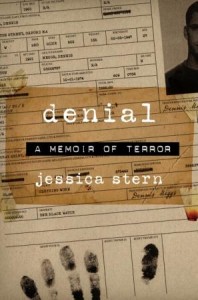
Let me shift gears now and talk about the book. Jessica Stern is a noted expert on terrorism. She served on President Bill Clinton’s National Security Council Staff and as a lecturer at Harvard. She received recognition from the FBI for her for her assistance in the effort to thwart international terrorism. If you met her today you might not even notice anything weird about her, even if she were wearing shorts. Jessica’s scars aren’t like mine. They aren’t splayed out all over her leg. She was raped at gun point when she was fifteen. She has been struggling to deal with the impact of that trauma her whole life.
Dr. Stern decided to request the police file on her rape case in the hopes that reading the file might help her in some way. The lieutenant who responded to her request was so moved by what he read in her file that he decided to re-open her case.Denial: A Memoir of Terror is her account of those events and the discoveries that follow.
I would love to say that with the help of her loving husband, a hard-working assistant, and a committed police lieutenant Dr. Stern solved the case and as the credits roll we see her walking into the sunset with a smile. I wish that this journey took her to some place psychologically where she no longer feels pain or shame. But, this isn’t fiction. This is her life. This is a woman who is smart and strong; a woman that other women envy, a woman who sits with terrorists! Yet, the thing I am most awed by is her courage in telling her story. She had the courage to share the most intimate and painful experiences of her life in order to help others heal.
It wasn’t until I read her book that I began to acknowledge that I might actually suffer from PTSD. I started to understand a little better why people hoped I would just “get over” my accident. Rather than questioning, “Have I healed?” I have started asking, “What does it mean to heal?” I truly believe that anyone who has suffered though a traumatic event will feel a kinship with Dr. Stern. Even though my trauma wasn’t the same as hers and even though I don’t suffer with the same symptoms as her, I feel a connection to her.
I would recommend this book without hesitation. I am typically a happy-ending kind of girl. If there is a remote chance that a book or movie will be sad, I avoid it. However, reading about Dr. Stern’s rape and subsequent struggles helped me begin to acknowledge my own trauma. This book was, for me, life-changing. Five stars.
Book Nook Club is the first stop on a book tour for Denial: A Memoir of Terror. The next stop will be on Wednesday at http://www.takemeawayreading.com/
(I received a free uncorrected proof of this book for the purposes of review.)
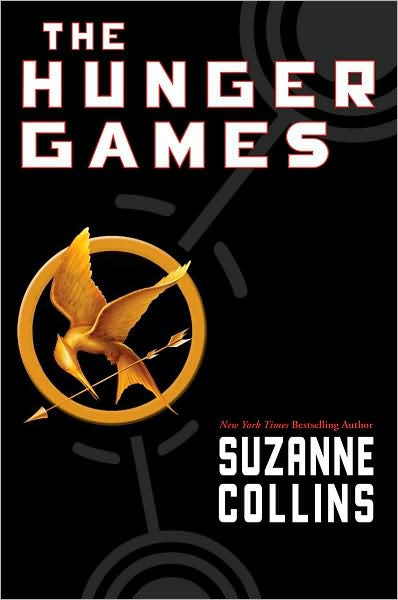
If you are looking for my current book recommendation, this is it. This is one of those books that I've heard the name mentioned numerous times by friends and family but never really knew what it was about until a couple of weeks ago when my friend, Kaylyn, told me the storyline. As a girl that loves the Ender's Game series and well anything that has to do with a game, I knew I needed to read this soon. I started yesterday afternoon and finished it this morning. It's a fairly easy (but not shallow) read and once you pick it up, you won't be able to stop reading until you know who comes home the victor.
The basis of The Hunger Games is a world set in the future where everyone lives within one of 12 districts. Every year a boy and a girl between the ages of 12-18 are picked at random from each district to compete in the annual Hunger Games - a survivor style competition to the death. Only one competitor can come home alive and as the victor. This book follows the two chosen from district 12 as they fight for their lives.
It sounds cruel and disturbing, and it is. But more than that, it is fascinating, intriguing, and a page turner. Collins' writing is easy to the read and to the point but has a lot of depth as well. She develops her characters extremely well and leaves you with a great deal of sympathy for all of the competitors, hoping that maybe just this once they can all make it out alive. I won't ruin anything else for you other than to say that I highly recommend this book for anyone (men, women, teens, adults, etc.). Just know that when you buy this one you should probably buy the sequel Catching Fire as well. 5 stars.
This past weekend we decided to drive down to Ohio. On the way out I picked up eight books on CD to get me through the drive while my husband was studying. This was one of those books. I read and reviewed One for the Moneya little while back and greatly enjoyed my first encounter with Stephanie Plum. Plum Lovin' follows Stephanie on a much different path than One for the Money, the path of playing matchmaker to a group of people who need some relationship help. The plot wasn't nearly as intriguing to me as her trying to catch tricky criminals. The book was extremely predictable and although it did make me laugh numerous times, lacked in any depth. It was good for entertaining me on a long drive, but I'm not sure I would recommend it for anything other than a quick beach read. 2 stars.
As a rule, I usually avoid Christian romances. I only read them when my mom lends them to me and I feel obligated, and they're almost always nauseating. Particularly annoying to me is the cover art. I've noticed the same thing on cover art for Christian music CD's. Christian hair and make-up is just a little more plastic, a little more Mattel. It almost looks like it can be snapped off and replaced à là Potatohead.
The cover for this book is not an exception, as you can see. But the rest of the book is, sort of. Like much of Christian romance, the subject matter is not deep, though it does go past the wading area into that section where the floor of the pool begins to slant and you have to lift your chin to stay above the surface. The language is basic, but it's not sappy or sentimental, which I appreciated.
Best of all, Hatcher managed to create a fresh story while continuing to follow the requisite romance formula (say what you will about formula, it sells for a reason). Her characters are well-rounded without excess description, and defy stereotypes without also defying nature or history, a trap many romance novelists fall into (i.e. pants-wearing sword-waving medieval princesses). The only time I felt like muttering "blah blah blah" was when the heroine and her hero get holed up in a cabin in a snowstorm. It has to happen in every romance novel. One gets sick or injured, and the only possible nurse is the love interest. It has to be either that or a tandem horseback ride. I challenge you to find a romance novel that doesn't contain one of these two scenes.
I suppose you'd like to know what the book is actually about. This is the third of a series called The Sisters of Bethlehem Springs. Daphne McKinley is a 27 year old unmarried, independently wealthy "spinster" who writes dime novels under a pseudonym in her spare time. Her novels are based on real local stories she picks up from old-timers. The grandson of one of her characters lives in St. Louis, and when he finds out someone is writing unfavorably of the grandfather he knew to be a good man, he wants to find the author and demand a retraction. You can guess the rest.
I have to say, I really enjoyed this book. It was a light refreshing read that I had a hard time putting down. I finished it three nights ago, and I keep getting the urge to go back to it, then feel disappointed when I remember there's no more to read. I will definitely have to read more by this writer.
(I received a free copy of this book for the purpose of review.)
I'm not usually a big reader of memoirs, but when the opportunity came up to review this book, I was really intrigued by the story. In the Sanctuary of Outcasts relates the experiences of Neil White during his time at a federal prison in Carville, Louisiana. Sentenced to eighteen months for kiting checks, White finds himself sharing a building with the last patients suffering from leprosy in the United States. Color me ignorant, but I had absolutely no clue that people were still suffering from leprosy in the U.S. as late as the 90s. This fact alone was enough to grab my interest in White's story, but the idea of housing these patients with convicted felons seemed to me to be just another dash of salt being added to the wounds of these afflicted souls.
White's story is not unusual in its inception. Convicted of a crime motivated by greed and the desire to maintain an impressive persona, he is sent to what one fellow prisoner refers to as a "country club" of prisons, complete with a golf course, playground, and jogging track. No bars on the windows, no locks on the doors. In fact, White relates how he told his children that "Daddy is going to camp" as a way to explain his prolonged absence. This memoir is not just another "I fought the law and the law won" story, however. Neil White's story is not so much about him and his journey to prison, but more about the stories of the patients who called Carville their home. The "outcasts" like Ella, Harry, and Jimmy have been cast out of society, set apart and kept isolation. Some have heartbreaking stories of being hunted like animals because of their disease or having their newborn children taken from the birthing bed to be raised by another. As he learns their stories, the wounds of the leprosy patients begin to disappear for White and he starts to realize that in fact they are not the outcasts at Carville. He is.
This is a moving story, told in an honest, readable style. White uses a conversational, sometime humorous tone, to tell his story interwoven with the story of the Carville residents. At one point in his journey, White realized that he would no longer behave in a manner to seek the approval and praise of others, but I still praise the work his has done with this memoir. He has honored those whom he once set out to exploit for his own gain. In the Sanctuary of Outcasts is a witty, candid tale of redemption that kept me riveted from beginning to end. I highly recommend it! 4 Stars.
You may have read our review of The Girl who Played with Fire, the second in this series, but I thought I'd also share a review of the book that precedes it. I'm sure I'm the last person to have read it, but just in case there's a few more of you out there, I hope my review is helpful.
The Girl with the Dragon Tattoo is a crime novel, set in present-day Sweden. It follows Mikael Blomkvist as he uncovers the truth behind the mysterious disappearance of Harriet Vanger, the niece of a wealthy former head of Swedish industry. In return, he's able to repair his own reputation, which fell after he was convicted of libel in his reporting of a corrupt financier. He's aided by the quirky, anti-social researcher Lisbeth Salander -- the girl with the dragon tattoo.
Overall, I enjoyed the book -- though it wasn't what I expected. I expected a little more suspense. I thought it's "page-turner" characteristics would be a bit more, well, page turner. But, the pages still turned quickly enough since I finished it in about a week (quick for me!)
Plot: I enjoyed the murder mystery aspect that pervaded the majority of the novel. But I could have done without the financial intrigue that launched and concluded the story. I understood why it was there -- without it, Mikael never would have embarked on his quest or met Lisbeth. But for me, it was a little too detailed and hard to follow.
But maybe that's because I don't get finances!
Characters: I loved Mikael. I felt like he was the perfect un-detective and I could really sink my teeth into him. As for Lisbeth, she was a little too counter-culture for me. Larsson did an excellent job writing his characters, because you could feel Lisbeth's coolness coming off the page. I just wished she had a little more heart and I'm wondering if I'll see more of her personality in the other two books.
As for the other characters...there was a lot. Thank God there's a visual family tree to help the reader keep all of the Vanger's straight. The family got a bit confusing at various points because I was trying to keep track of all of them in relation to Harriet.
Structure: Chapters were organized by dates, which I could have done without. I suppose it helped me follow a timeline, but for me, the timeline wasn't necessary. As I said, I appreciated having the family tree, but I also wished there was a map of Hedestad (where the majority of the book takes place). Larsson made mention of lots of physical locations and their relation to one another as Mikael tries to solve Harriet's disappearance. I must be a visual learner, because I had trouble picturing how all of the locations were connected just based on the words on the page.
Otherwise, the language was easy to follow (except for all that pesky financial stuff I mentioned above!) and the 590 pages were a relative breeze. I'm looking forward to reading the other two! 4 stars.